

















































Your cart is currently empty.



RCGO–SVP, BFSI | SpeedTech.ai
Through Intellipaat’s Product Management training, I transitioned from an IT Director to Regional Chief Growth Officer, gaining strategic product expertise and achieving a remarkable 50% salary hike within just a few months.
Director BFSI Transformation
RCGO–SVP, BFSI

Business Analyst | DynaTech Systems
With Intellipaat’s structured Product Management training, I enhanced my analytical and product skills, accelerated my professional growth, and secured a remarkable 50% salary increase.
Business Analyst
Senior Business Analyst

Branch Manager | IndiaMART
Balancing work with Intellipaat’s live and self-paced Product Management training gave me the confidence and industry knowledge to step up from Team Leader to Branch Manager, along with a rewarding 30% increase in salary.
Team Leader
Branch Manager

Team Lead | Omnicom Media Group
Through Intellipaat’s Product Management program, Bargava advanced from Senior Analyst to Team Lead, earning a 20% salary hike while strengthening his leadership skills and accelerating his professional growth.
Senior Analyst
Team Lead

Product Specialist | Backbase
The Product Management training at Intellipaat gave me practical industry exposure and strong product insights, helping me transition from a Business Analyst role to a Product Specialist position with a 15% salary growth.
Business Analyst
Product Specialist

Lead Product Owner | Infinite Computer Solutions
Intellipaat’s Product Management course helped me transition into a Product Lead role through structured learning, mentor support, and real-world assignments.
Product Owner
Lead Product Owner
55% Average Salary Hike
$1,30,000 Highest Salary
45 LPA Highest Salary
12000+ Career Transitions
3100+ Hiring Partners
Career Transition Handbook
This course, created in collaboration with IIM Ranchi, will help you become part of the next generation of product management professionals. It covers the product life cycle, product vision, strategy, research, and more.
In this product management course by IIM Ranchi, you will learn these skills:
MS Excel: Analyze data and create insightful reports using advanced functions and pivot tables.
Figma: Design user interfaces and prototypes for user-centered products.
Jira: Manage agile projects by tracking tasks, backlogs, and sprints efficiently.
Google Analytics: Analyze user behavior to optimize product strategies and improve user experience.
Product Strategy Development: Create effective strategies by understanding market needs and competition.
User Research and Testing: Gather feedback through user interviews and usability testing.
Agile Methodologies: Apply Scrum and Kanban for flexible and collaborative product development.
Here are a few reasons why you should pursue a career in product management:
Opportunity to Drive Impactful Change: Product managers guide product strategy, aligning business objectives with user needs and creating tangible impacts on company success.
Competitive Salaries: In India, the average salary of an experienced product manager ranges between INR 20-30 lakh annually, whereas in the US, they earn around $12,00,000 annually.
High Demand and Career Growth: LinkedIn shows that more than 30,000 jobs are available in India and more than 1,39,000 in the US.
Access to Various Technology: Work with Excel, and data analytics, staying at the forefront of digital innovation.
A product manager is responsible for guiding a product from idea to launch. They work with marketing, engineering, and design teams to understand customer needs, define product features, and ensure everything aligns with the company’s goals.
There are 25+ courses in this product management program, with multiple real-world case studies and industry-oriented projects.
Course 1: Preparatory sessions on Excel for Data Analytics
Course 2: Introduction to the Project Management tool – Jira
Course 3: Introduction to Figma for UX Design
Course 4: Introduction to Product Strategy & Management
Course 5: Product Life Cycle and Strategy
Course 6: Strategic Market Analysis
Course 7: Product Ideation and Validation
Course 8: Customer-Centric Product Design & Prototyping
Course 9: Competitive Advantage in Product Strategy
Course 10: Product Engineering Strategies
Course 11: Product Launch & Go-to-Market (GTM) Strategies
Course 12: Competitive Strategies and Market Positioning
Course 13: Branding & Product Positioning
Course 14: Product Pricing Strategies
Course 15: Growth Strategies and Competitive Edge
Course 16: Disruptive Innovation & Strategic Planning
Course 17: Product Analytics and Its Importance
Course 18: Product Analytics Process
Course 19: Metrics and Goals in Product Analytics
Course 20: Data Cleaning, Coding, and Preparation
Course 21: Descriptive Analytics for Product Management
Course 22: Predictive Analytics for Product Management
Course 23: Analysis for New Product Development
Course 24: Consumer Behavior Analysis
Course 25: Digital Analytics: Tools and Techniques
Course 26: Product Promotion in Digital Space
Course 27: Product Distribution & Support
Course 28: Innovative Communication and Storytelling
Course 29: Strategic Business Case Studies
Talk To Us
We are happy to help you 24/7
Dr. Satyam is an Assistant Professor of Marketing at IIM Ranchi. He holds a PhD from IIM Lucknow and a BE from DCE. His research interests include retailing, rural marketing, and marketing in underdeveloped or bottom-of-the-pyramid contexts.
Dr. Shweta Jha is an Assistant Professor at IIM Ranchi. She has completed her Ph.D. in Marketing from IIM Indore and an MBA from IIIT Gwalior. Her specializations include Consumer Psychology and Behavior, E-Commerce, and related fields.
Dr. Aditya Shankar Mishra has 10+ years of experience and did his MBA and Ph.D. in Marketing from ICFAI Hyderabad. He specializes in marketing analytics, brand management, and has published research papers in reputed journals.
Dr. Subhro Sarkar has over 10 years of experience and did his Ph.D. in Marketing from IIM Rohtak. He specializes in consumer behavior, retailing, and digital marketing, with research published in reputed marketing journals.
Dr. Mayank Jyotsna Soni is an Assistant Professor of Marketing at IIM Ranchi. She holds an FPM from IIM Ahmedabad and brings 10 years of teaching experience, specializing in Consumer Behaviour and Strategic Marketing.
Dr. Rajeev Verma is an Assistant Professor of Marketing at IIM Ranchi. He holds an FPM from IIM Indore and brings over 15 years of experience across industry, academia, consulting (including NITI Aayog), and startup mentoring.
Vishal is a product leader with 17+ years in supply chain and analytics, driving partner integration at Google Cloud. Formerly led digital transformations at Kimberly-Clark and Accenture. He is an alumnus of IIM Kozhikode.
Kapil Dongare, who holds an MBA from IIM Bangalore and an M.Tech from IIT Kanpur, has over 14 years of experience specializing in product management with a proven track record in the automotive and semiconductor industries.
Prashant Kumar, Senior Data and Analytics Engineer at M&G plc, B.Tech from IIT Gandhinagar and M.Tech from BITS Pilani. Experienced in data science, finance, e-commerce, supply chain, Git, data visualization, and cloud computing.
Charan Brahmandam is a Product Manager at Microsoft leading the roadmap for AI-driven Copilot Agents in Dynamics 365. An expert in AI product management and SaaS pricing, his decade-plus career is backed by credentials from ISB, SP Jain, and Kellogg.
Meenakshi Jaiganesh is a Platform Product Manager at Hexaware Technologies specializing in Cloud, AIOps, Automation, and Gen AI. With a background at HCL, CTS, and TCS, she drives $10M–$50M business impact through tailored enterprise IT infrastructure solutions.
Learners design a centralized Remote Work OS for distributed teams, create user personas, define collaboration workflows, build MVP roadmaps, identify success metrics, and develop enterprise adoption strategies.
Learners design an AI-powered resume optimization platform, create personas, define recommendation workflows, prioritize AI features, and develop a monetization strategy.
Learners design a healthcare-focused CRM solution, define patient engagement workflows, map integration requirements, prioritize features, create an adoption strategy, define success metrics, and identify privacy/compliance considerations.
Learners design a smart budgeting and expense-management app, define financial workflows, build reporting and analytics capabilities, create a monetization strategy, define retention loops, and identify key product metrics.
Learners design skill assessment flows, recommendation systems, learning pathways, engagement frameworks and user-success metrics.
Product Strategy
Product Roadmapping
User Research
Market Research
Product Analytics
AI for PM
UX Thinking
Prototyping
Agile & Jira
GTM Strategy
Pricing Strategy
Growth Strategy
Projects
Amazon wants to reduce cart abandonment during checkout. Create a PRD that identifies customer pain points, prioritizes new features, and defines KPIs to measure product success.
Walmart aims to improve inventory visibility across stores. Develop a Product Strategy Document covering the product vision, stakeholder analysis, roadmap, success metrics, and go-to-market strategy.
Netflix wants to increase Gen Z engagement through innovative viewing experiences. Conduct user research, prioritize features, define measurable KPIs, and create a 12-month product roadmap.
Uber is facing increased ride cancellations during peak hours. Create user personas, map customer journeys, identify pain points, and recommend product improvements backed by measurable success metrics.
Spotify aims to increase Daily Active Users and customer retention. Design a growth strategy using feature prioritization, A/B testing, product analytics, and launch planning to drive sustainable growth.
Excited to begin the Executive Certification in Product Management from Drishti IIT Indore & Intellipaat. Grateful for this opportunity to apply new insights to my current role.
Completed Intellipaat’s Product Management Certification, gaining practical experience across the lifecycle. Projects and a user-focused approach sharpened my strategic thinking.
The Product Management Certification from Intellipaat helped me build expertise in product strategy, user-focused design, and scaling products through hands-on projects and real-world case studies.
To take the admission in this course, a simple 3-step process is to be followed. Only the candidates who will be shortlisted through this process can get admitted to the program.
| Date | Time | Batch Type | |
|---|---|---|---|
| Program Induction | 18th Oct 2026 | 12:30 PM - 4:15 PM IST | Weekend (Sunday) |
This Executive Post Graduate Certification in Product Management course has been designed by top experts with a deep understanding of industry requirements. The course covers various projects and assignments that will help you become job-ready and taking on challenging roles within the product management industry.
This Executive Post Graduate Certification in Product Management offers in-depth knowledge, hands-on projects, expert insights, and networking opportunities to help you succeed in the product management field.
Executive Post Graduate Certification in Product Management offers a wide range of job opportunities, including:
These roles exist in various industries and companies of all sizes. With the increasing demand for skilled product managers, the field provides promising career prospects and growth potential. There are 30,000+ job opportunities for professionals in India alone and over 1,35,000+ job opportunities in the USA.
The average salary for professionals in product management roles varies based on experience and industry. Generally, entry-level positions start from ₹6,00,000 per annum, while mid-level positions range from ₹10,00,000 to ₹18,00,000 per annum. Senior roles, such as Senior Product Manager or Head of Product, can command salaries upwards of ₹25,00,000 annually.
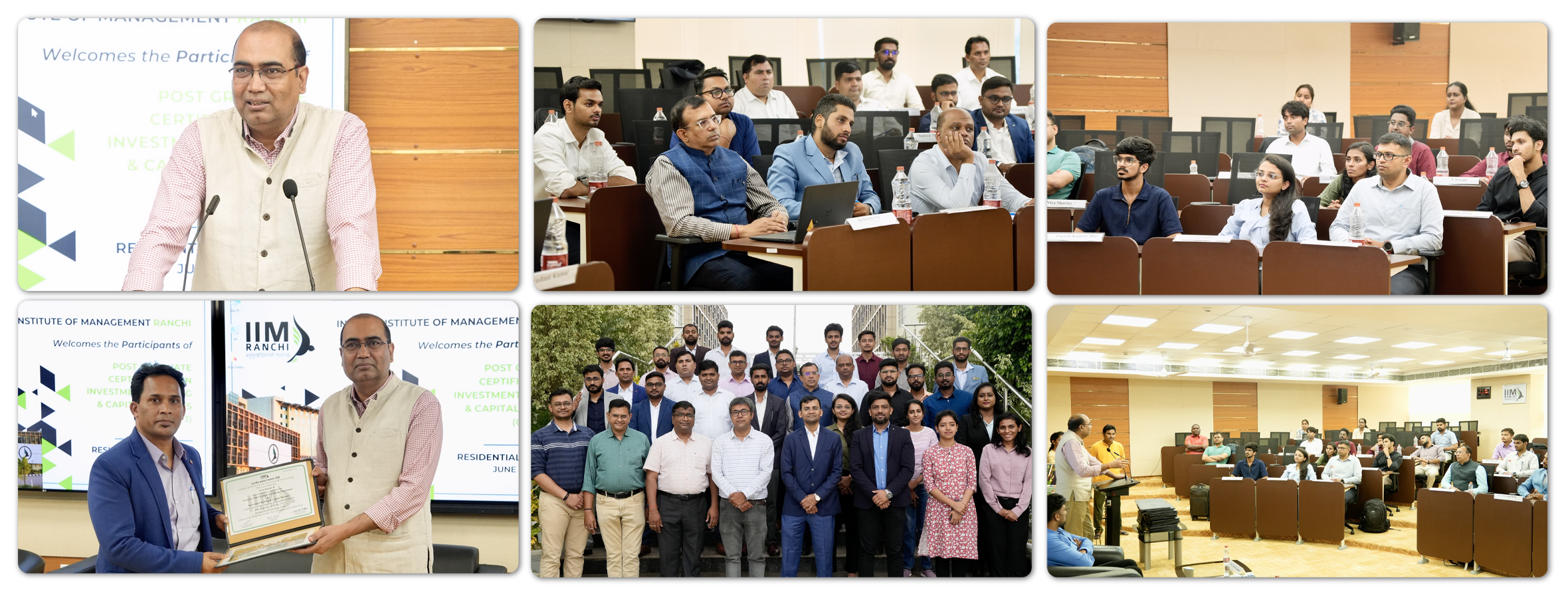
The course is taught by experienced faculty from IIM Ranchi and industry experts with extensive experience in product management. Practitioners from leading companies also provide insights into real-world challenges and best practices.
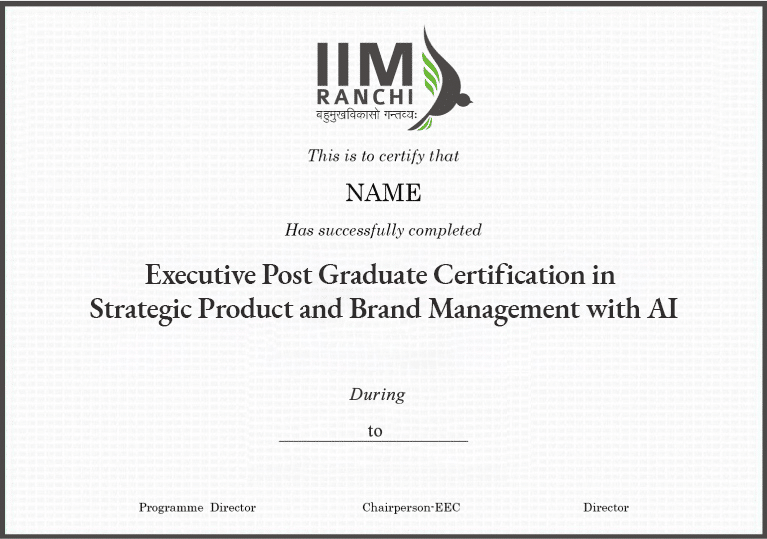
Upon successful completion, you will receive an Executive Post Graduate Certification in Product Management from IIM Ranchi, which is recognized and valued in the industry.
Intellipaat provides 24/7 query resolution, allowing you to raise a ticket to the dedicated support team anytime. You can avail of email support for all your queries. If your query is not resolved through email, we can arrange one-on-one sessions with our support team. However, one-on-one sessions support is provided for 9 months from the start date of your course.
Intellipaat actively offers placement assistance to all learners who have completed the training. For this, we are exclusively tied up with over 300 top MNCs. This way, you can be placed in outstanding organizations such as Sony, Ericsson, TCS, Mu Sigma, Standard Chartered, Cognizant, and Cisco, among other equally great enterprises. We also help you with the job interview and résumé preparation.
Yes, Executive Post Graduate Certification in Product Management is highly valuable. It validates your expertise and knowledge in product management and enhances your credibility in the job market. It demonstrates your commitment to professional growth and can significantly increase your chances of securing rewarding career opportunities.
This Executive Post Graduate Certification in Product Management course introduces various industry-standard tools and platforms used in product management. These may include market research tools like surveys and customer feedback platforms, data analytics software for analyzing product performance and user behavior, project management tools for organizing and tracking tasks, and collaboration platforms for seamless team communication and coordination.
Yes, as per our refund policy, once the enrollment is done no refund is applicable.
Upon completing the course, candidates can apply for executive alumni status by paying ₹10,000 + GST directly to IIM Ranchi.
The Executive Alumni Status (Optional) is available for INR 10,000 + GST, and includes the following benefits: