All Courses
×
iHUB IIT R

Electric Vehicle Course

40,091 Ratings

Ranked #1 Electric Vehicle Course by Education Times

  • Master MATLAB, EV design, architecture, battery technology and charging infra
  • Live EV course by top IIT faculty and industry veterans
  • Earn prestigious certification from iHUB, IIT Roorkee (Tech Innovation Hub at IIT Roorkee)
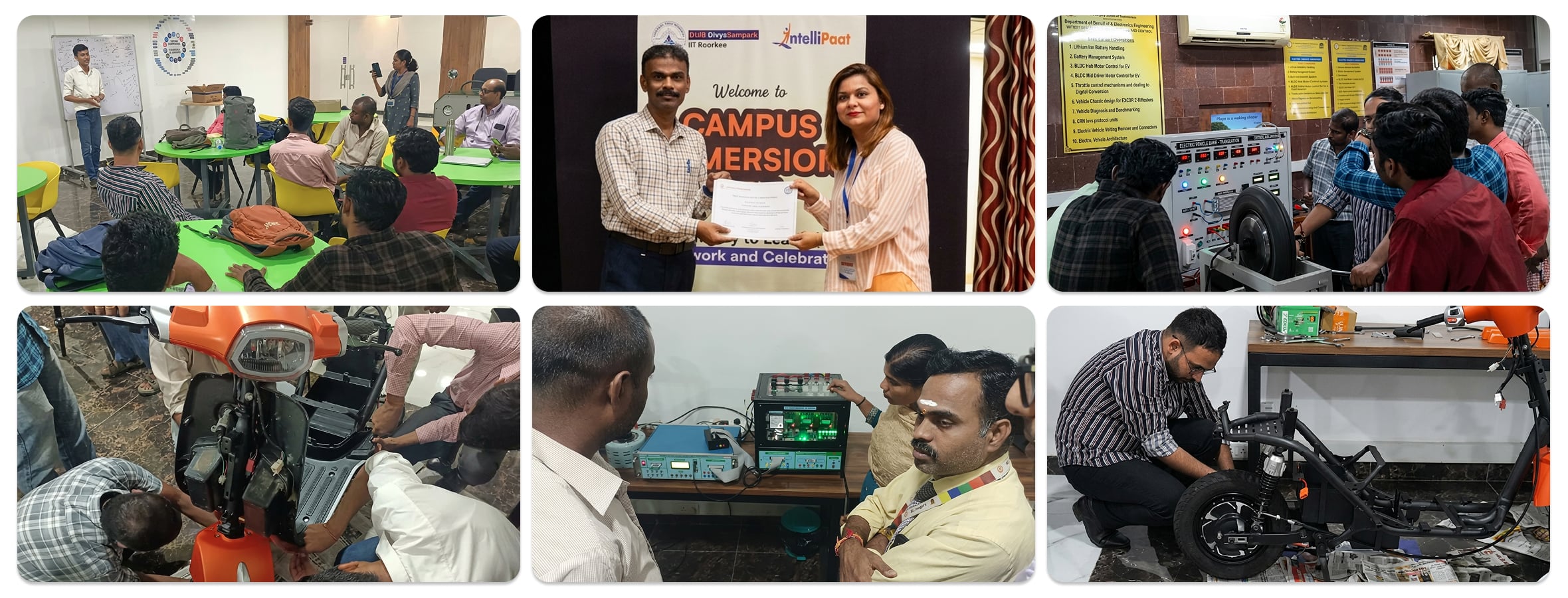
  • 2 days campus immersion at IIT Roorkee iHUB
Government-Certified & Approved:
ASDC NSDC
course intro video image
Course Introduction

Watch

Course Preview

Key Highlights

50+ live sessions across 6 months
Live classes from IIT professors and EV experts
1:1 mentor interaction and learning
2 days campus immersion at iHUB IIT Roorkee
Dedicated learning management team
Placement assistance and soft-skills sessions
Google-Reviews 3109
sitejabber 1493
mouthshut 24542

Electric Vehicle Course Overview

What does this Electric Vehicle course cover?

In this Electric Vehicle course, offered by Intellipaat in collaboration with iHUB DivyaSampark, IIT Roorkee, you will complete 10 comprehensive modules, work on real-world projects, and gain hands-on experience.

Online Instructor-led Interactive Sessions:

Course 1: MATLAB Coding and Simulink Fundamentals
Course 2: Vehicle fundamentals and components of ICE Powertrain
Course 3: Voltage Control
Course 4: Battery Swapping and Basics of EV Charging
Course 5: Modeling for SMD System
Course 6: Battery Fundamentals and modeling BMS
Course 7: Charging Station components and building Fast Chargers
Course 8: Kinematics and Control of Autonomous Vehicles
Course 9: Physics and Mechanics for EV
Course 10: Electromagnetic Energy and Signal Processing

Additionally, this program includes a Capstone Project on Electric Vehicle Design and multiple hands-on workshops to enhance your expertise in EV architecture, battery systems, powertrain design, and charging infrastructure.


  • Gain expertise in designing, analyzing, and operating Electric Vehicles.
  • Master the electric vehicle technology, battery management systems, and powertrains.
  • Learn about the architecture and operations of hybrid electric vehicles (HEVs).
  • Learn setting up EV charging infrastructure and energy storage management systems.
  • Understand the concepts of electromobility, steering dynamics, cable harnessing, and EMC simulation.
  • Work on industry tools and software to run simulations.

The key skills you will master in this EV course are:

EV dynamics, Battery management analysis, MATLAB and Simulink simulations, EV charging infrastructure, important concepts related to EV safety, Autonomous vehicles and EV design.

Electric vehicles are the next big thing in the automotive industry. From global automobile majors like General Motors, BMW, Volkswagen, and Mercedes Benz to Indian giants like Tata Motors, Mahindra, and Maruti Suzuki, automotive companies are innovating and expanding their electric vehicle portfolios.

The entry-level salary for an EV engineer in India is anywhere between ₹6-8 lakhs per annum, while experienced professionals in specialized roles can earn upwards of ₹15 lakhs per annum.

After completing this electric vehicle training in India, you will be able to work in various exciting roles like EV Designer, Electric Powertrain Engineer, Battery Engineer, Charging Infrastructure Specialist, or even EV design consultant. Top automobile players like Tata Motors, Mercedes Benz, General Motors, Renault and Nissan are already actively hiring electric vehicle designers.

This electric vehicle course is designed in consultation with EV industry veterans and subject matter experts. This course offers you 24/7 support and comes with a lot of practical exercises that will help you master top EV skills. You will learn from IIT Faculty & Industry experts and apply the gained knowledge in doing company-oriented capstone projects.

You will also work with simulation software packages to gain practical experience.

Our offline workshops provide hands-on experience with real-life projects, and give practical exposure on component assembly, battery systems, sensor integration, sensor analysis, charging technologies, and more.

  • Graduates, ITI certificate holders, and diploma holders
  • Anyone looking to gain skills in electric vehicle technology
  • B.E/ B.Tech/ M.E/ M. Tech graduates looking to develop skills in EV design or project management
  • Professionals working in the automotive sector who want to pursue a career in EV technology
  1. Master EV fundamentals such as EV architecture, battery systems, and powertrains.
  2. Master MATLAB and Simulink to run simulations for EV design and analysis.
  3. Learn to work with battery management systems and run optimization simulations.
  4. Design and simulate EV charging systems.
  5. Gain practical skills by working on industry-relevant projects.
  6. Develop an in-depth understanding of how autonomous EV systems and smart mobility work.
  7. Learn about Global Standards for EV safety, and compliance.
  8. Enhance soft skills and interview readiness with our Career Services.
  9. Learn from IIT faculty and industry leaders.

By completing this EV training, you will be ready for a successful career in the EV industry.

View More

Talk To Us

We are happy to help you 24/7

Career Transition

60% Average Salary Hike

$130,000 Highest Salary

₹50 LPA Highest Salary

11,000+ Career Transitions

3,100+ Hiring Partners

Career Transition Handbook

*Past record is no guarantee of future job prospects

Meet the Mentors

Top Job Roles for Electric Vehicle Professionals

Battery Manufacturing Engineer

They work on various chemical compositions to improve battery output, efficiency and safety.

Automotive Control Systems Engineer

They develop algorithms for battery management systems and IoT modules that deliver real-time EV operational data.

EV Design Engineer

They work on motors and batteries to ensure they are within optimal thermal and operational ranges.

Electronics & Communications Engineer

They ensure the driver circuits, wiring systems and data transfer mechanisms are always fine-tuned.

Powertrain Systems Engineer

They focus on performance and improving the electric drive system.

EV Urban Planner

Creates and plans the infrastructure required for EV charging and collaborates with governments and other stakeholders.

View More

15+ Skills Covered

Vehicle Fundamentals

Battery Technology

Battery Sizing

Battery Management System (BMS) Development

MATLAB Simulink

Mechanical sub-systems

Charging Infrastructure

Low-voltage Systems

Testing of EVs

MATLAB Programming

MATLAB Plotting Functions

Debugging Tools

MATLAB ODE Function

Simulink Library Browser

MATLAB for EV Simulation

View More

Top EV Tools to Master

Matlab MS Visio simulink

EV Course Fees

Online Classroom Preferred

Weekend (Sat-Sun)

25 Jul 2026 07:00 PM - 10:00 PM
$1369 10% OFF Expires in

Corporate Training

  • Customized Learning
  • Enterprise Grade Learning Management System (LMS)
  • 24x7 Support
  • Enterprise Grade Reporting

Contact Us

Electric Vehicle Training Curriculum

Live Course Industry Expert Academic Faculty

MATLAB Coding and Simulink Fundamentals

Preview
  • Get familiarised with the MATLAB coding and Simulink environments.
  • Get introduced to MATLAB software and coding fundamentals.
  • Model, Simulate, and analyze dynamic systems using MATLAB Simulink.
Download Brochure
  • Plot 2D and 3D graphs in MATLAB, work with functions, generate scripts, and create annotations.
Download Brochure
  • Create matrices, perform mathematical operations, trigonometric functions, algebraic and differential equations. Learn numerical integration.
  • Learn the Interpolation method and understand pseudo functions in MATLAB.
Download Brochure
  • Understand electric vehicle market and growth trends, Study the basic block diagram of an electric vehicle, its main components, and the operating principles of each component. Learn the importance of EV chargers.
Download Brochure
  • Learn about conventional vehicle layouts and the components of an ICE powertrain.
  • Know about engine subsystems, power losses during power transmission, and different vehicle types based on their energy sources.
  • Learn how power is used in a vehicle: Degree of Hybridization, architecture, and position of electric motors.
  • Learn about EV architecture layouts, including hybrid vehicle layouts and the classification of HEVs.
  • Learn about Electric Power Drive Systems, Battery Management System (BMS), Auxiliary Subsystem, Electric Propulsion Subsystem (Wheel and Tire).
  • Learn about the components of a vehicle’s powertrain: Electronic Controller, Power Converter, Electric Motor, Manual Transmission.
  • Understand and compare EVs and ICE vehicles.
Download Brochure
  • Understand the types of subsystems in the Vehicle: Steering System & its types, Suspension System (Wheel and Tire alignment), Braking System, Chassis System, Transmission System, and Thermal management.
Download Brochure
  • Learn about Voltage Control Methods in power systems and power management, understand the different types of EV batteries, and learn about connected vehicle technologies, such as V2V, V2G, etc.
  • Delve into how Electric Vehicle Communication happens, along with enhanced vehicle control and In-Car Communication Protocols. Understand EMC and EMI mitigation techniques.
Download Brochure
  • Battery specifications in various EV segments and details about charging methods and power ratings.
  • Learn manual and automated battery-swapping methods and explore the advantages and challenges of battery swapping.
Download Brochure
  • Gain knowledge of topics such as Mathematical modelling, simulation time, solver configuration, and subsystem creation.
Download Brochure
  • Learn to implement Simulink blocks, including Function blocks, and use Scope blocks effectively.
  • Modeling of Basic Mathematical and Algebraic equations.
Download Brochure
  • Introduction to Linear & Non-linear systems, modeling a Spring Mass Damper System & its Responses, and understanding the characteristics of system responses.
  • Learn about the simple harmonic oscillator (SHO): A special case of SMD system (Undamped response) and create a model of SHO using Simulink.
Download Brochure
  • Explore the time domain, frequency domain, transfer functions, and their relationship to state-space representations. Learn the Basics of Laplace transform.
  • Obtain the transfer function of a spring-mass-damper system and model the system.
Download Brochure
  • Learn Motor ratings and requirements of motors in EV/HEV. Get to know about the Types of Motors used in Vehicles and understand characteristics like Torque and speed control. Also, delve into Motor drives and converters used in EV.
Download Brochure
  • Learn to model a Battery and the advantages/disadvantages involved in the process.
  • Understand the Characteristics of the battery cell and the importance of Battery sizing.
  • Understand the objective of BMS, the importance of Charging and discharging control in batteries and cells.
  • Get Familiarized with the architecture of BMS. Learn the Battery safety methods components of EV battery chargers and standards.
Download Brochure
  • Learn the importance of EV supply equipment and EV battery chargers’ components. Know the different types of Chargers, Plugs, and Charging standards.
  • Know the Classification of chargers/charging types based on charging levels (region-wise), modes, and plug types.
  • Get to know the Standards related to connectors, communication protocols, supply equipment, and communication protocols and procedures for types of EV chargers.
  • Delve into the Converters used in EV chargers.
Download Brochure
  • Get to know charging station components and charging speed. Also, learn the Topologies and strategies used in fast chargers.
  • Learn about renewable energy integration and solid-state transformers.
  • Understand types of converters such as DC/DC and AC/DC.
  • Learn to Design and simulate AC and DC charge controllers.
Download Brochure
  • Understand autonomous vehicle kinematics, constraints, and the control of reference position and pose.
  • Learn about the control of autonomous vehicles using kinematics and Lateral Vehicle Dynamics.
  • Delve into the Explore levels of driving automation and control technologies, including ADAS features and components.
  • Work on Layers of Motion Planning for Autonomous Vehicles, along with path-planning methods.
Download Brochure
  • Learn about the different methods of EV Testing, such as Penetration Testing, Thermal Testing & Non-Destructive Testing.
Download Brochure
  • Understand the basics of Ohm’s Law and DC vs. AC current, Series Circuit vs Parallel Circuit, resistors, capacitors, and inductors.
  • Get to know voltage divider, magnetic field, right-hand rule, conductors, insulation, and semiconductors.
  • Learn about Diodes and different types of transistors such as BJTs, MOSFETs, and IGBTs. Also, delve into various Laws of Electromagnetism and Energy Loss. Understand Lenz’s law.
  • Learn about the basic terminology of Motor & Inductance.
Download Brochure
  • Delve into Newton’s 3 Laws of Motion, along with Kinematic Equations for Linear Motion & Angular Motion.
  • Understand Basic concepts such as Force, Energy, Work, Power, Pressure, Pascal’s Law, frictional force and Aerodynamic Drag.
Download Brochure
  • Learn about Electromagnetic energy, Moment of Force, and FFT of Square Waveforms, along with basic Integration of Functions of Time.
  • Get introduced to Magnetic Dipole and rotating Magnetic Fields. understand what coils are, coil sides & turns in a coil, Full Pitch and Short Pitch.
Download Brochure
  • Get introduced to concentrated and distributed windings, PID Controller Operation, and Reference Tracking. Learn about the Laws of Electromagnetic Induction along with Lenz’s Law.
  • Know about the different types of Electric Motors, including the basics of Induction Machine Operation. Learn about Steady-State Equivalent Circuits and the types of Inductances.
Download Brochure
  • Learn about slip in an induction machine, Synchronous Machines, and Electrical Machine Losses.
  • Get started with Power Electronic Devices, understand Voltage and Current in Electric Machines and DC Machine Speed Control.
Download Brochure
View More

Electric Vehicle Projects

Career Services

Career Services
guaranteed
3 Guaranteed Interviews
job portal
Exclusive access to the Intellipaat job portal
Mock Interview Preparation
1 on 1 Career Mentoring Sessions
resume 1
Career-oriented sessions
linkedin 1
Resume & LinkedIn Profile Building
View More
Electric Vehicle Design Course Click to Zoom

Electric Vehicle Certification

About iHUB DivyaSampark, IIT Roorkee

iHUB DivyaSampark at IIT Roorkee was created under the National Mission on Interdisciplinary Cyber-Physical Systems. The Department of Science and Technology supports this initiative.

The Automotive Skills Development Council (ASDC) aims to improve the skills of India’s automotive workers. They focus on ongoing development, re-skilling, and up-skilling programs. ASDC focuses on aligning the workforce’s skills with the evolving demands of Industry 4.0, including robotics and electric vehicles.

The National Skill Development Corporation (NSDC) aims to empower India’s youth through skill development under a Public-Private Partnership (PPP) model. The NSDC mission focuses on skilling, reskilling, and upskilling 25 million individuals, including 15 million from disadvantaged socio-economic groups, and operationalizing 50,000 skills centres.

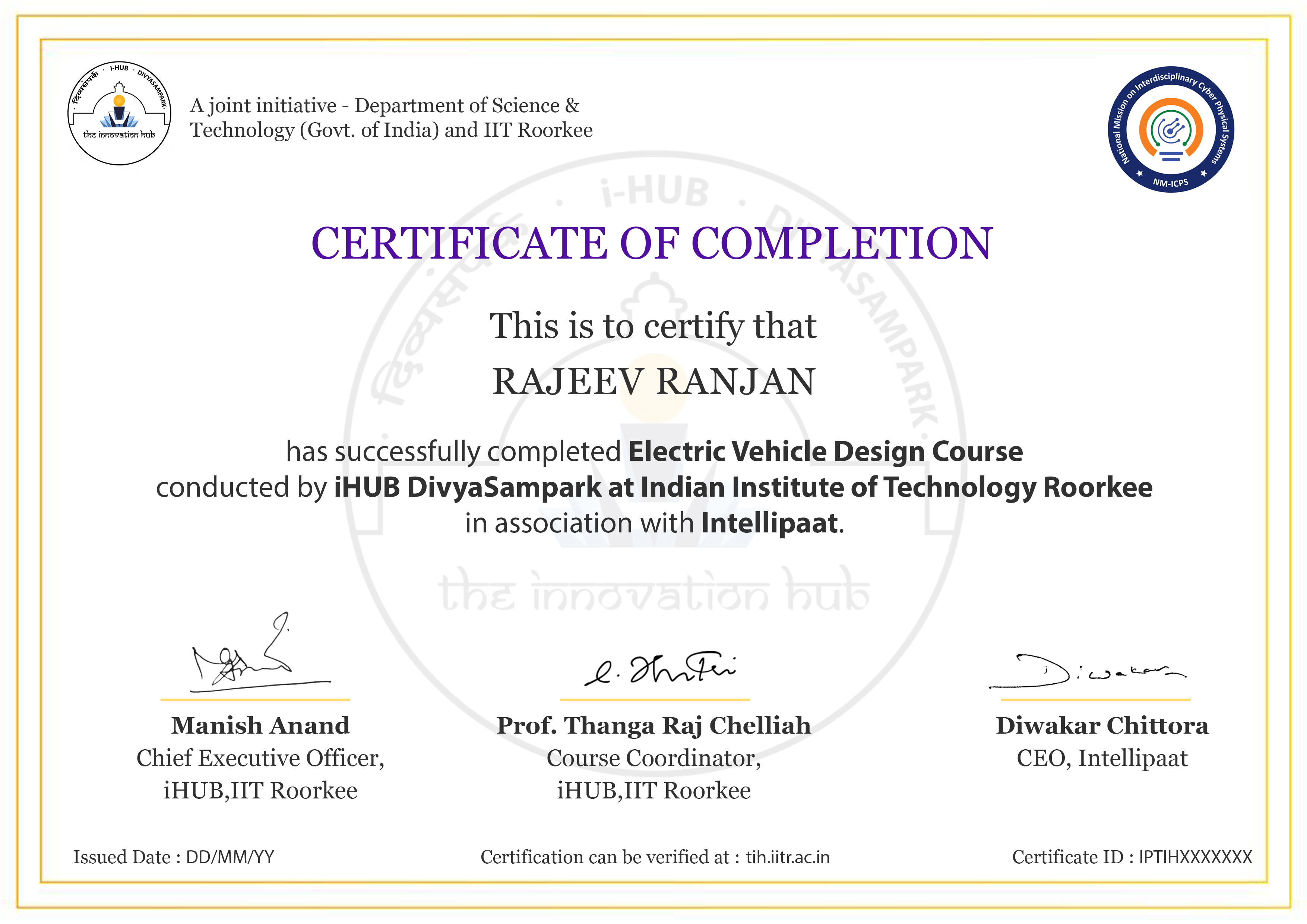
Upon successful completion of the program, you will receive the following certifications:

Get an industry-recognised certification from iHUB, IIT Roorkee

  • This certification validates your expertise and skills in electric vehicle design, endorsed by a prestigious institution.

Get Government approved ASDC certification

  • The Automotive Skills Development Council (ASDC) certification acknowledges your competency in the automotive industry, specifically in electric vehicle technologies.

Get Government approved NSDC certification

  • The National Skill Development Corporation (NSDC) certification confirms your proficiency and training in electric vehicle design and related skills.

To earn the Advanced Certificate in Electric Vehicle Design, learners must successfully complete the course, required projects and assignments, and score at least 60% in the certification examination. Eligible learners will then be awarded the applicable programme certificate in Electric Vehicle Design by iHUB, IIT Roorkee and Intellipaat.

Course Reviews

(40,091)

Get hands-on experience with real EV components through an offline workshop focused on industry-aligned projects.

Get hands on experience with real EV components Desktop Image

Our alumni work at leading EV companies

EV Alumni Image For Desktop

FAQs

What software will I learn in this EV training?

You will learn MATLAB, Simulink, and other simulation software to complete practical exercises.

This training equips you with critical skills in EV system design, battery management, and charging infrastructure. You’ll gain practical experience in simulation and modeling, and insights into advanced technologies. These qualifications enhance your employability in the rapidly growing EV sector.

Electric vehicle design involves designing vehicles powered by electricity rather than conventional internal-combustion engines. In this course, you will work on design analysis, battery thermal management, safety principles, and more.

The EV Industry has huge job prospects. The shift from conventional vehicles to electric vehicles is transforming the automotive industry and driving significant changes in vehicle technology, manufacturing, and mobility. By 2026, electric vehicles will have risen from 3% to 23% of the worldwide market.

The Electric Vehicle Design Course incorporates mechanical and automotive engineering principles by focusing on designing, optimizing, and integrating various vehicle subsystems. Engineers apply mechanical engineering concepts to understand and develop components like the steering, suspension, and thermal management systems.

Automotive engineering principles are used to address aspects such as vehicle dynamics, powertrain design, and overall vehicle performance. This approach helps students understand both fields related to electric vehicle development.

Leading automotive industry manufacturers like Daimler, TATA Motors, Mahindra, Hero, Tesla, Rivian, and others are hiring EV designers. Even multiple tech companies like Google and Apple are building software’s and utilities for the EV cars and are hiring at multiple levels.

No, it is possible to start a career in electric vehicle design without a degree.

Yes. We provide mock interviews to help learners practise realistic interview scenarios. This can help build your confidence and improve your chances of success.

Yes. Intellipaat provides practice exams for the Electric Vehicle course to help you strengthen your subject knowledge and prepare for assessments.

The process for getting into the placement pool is:

  1. You have to complete the course along with the submission of all projects and assignments.
  2. Then you have to pass the Placement Readiness Test (PRT)
  3. Once you clear PRT, you will get access to our job portal.

Intellipaat offers query resolution, and you can raise a ticket with the dedicated support team at any time. You can avail yourself of email support for all your queries. We can also arrange one-on-one sessions with our support team if your query does not get resolved through email. However, 1:1 session support is given for 6 months from the start date of your course.

Intellipaat’s career services are designed to help you prepare for opportunities in the EV industry. This course will help you prepare for interviews for EV-related roles. Our placement services will help in mock interview preparation, soft skills enhancement, and helping you connect with EV employers

Our offline workshop provides practical, hands-on exposure that can help strengthen your technical interview preparation.

The course may include webinars with senior EV industry leaders and CXOs, who share insights into current industry trends. Learners developing an EV startup idea may also receive guidance on preparing and presenting their pitch.

IIT Faculty will take the following modules:

  • Motor rating and speed control methods
  • Battery fundamentals and BMS modelling
  • EV Charging and Infrastructure
  • Kinematics and control of Autonomous Vehicles

No, our job assistance is aimed at helping you land your dream job. It offers a potential opportunity for you to explore various competitive openings in the corporate world and find a well-paid job, matching your profile. The final hiring decision will always be based on your performance in the interview and the requirements of the recruiter.

Yes, we provide physical labs for electric vehicles.

Yes, this program is completely aligned with the future of the electric vehicle automotive industry.

Offline physical workshops will be scheduled at the end of the program. Interested participants must make an additional payment of ₹20,000 (inclusive of GST) to attend the workshop.

Eligible learners may have an opportunity to submit qualifying startup ideas for review under applicable iHUB DivyaSampark programmes. Funding and incubation support are subject to programme eligibility, evaluation, selection, and applicable terms.

Additionally, candidates who are currently enrolled in a degree program and have their startup idea approved may also receive a monthly fellowship/scholarship of ₹8,000 during the early phase of their project to encourage and support innovation.

View More