



















































Your cart is currently empty.
What we provide?
- Placement Assistance
- Exclusive access to Intellipaat Job portal
- Mock Interview Preparation
- 1 on 1 Career Mentoring Sessions
- Career Oriented Sessions
- Resume & LinkedIn Profile Building
 All Courses
×
All Courses
×


Sr. AI/ML Developer | Aorbis
Enrolling in an AI program boosted my career, transitioning me from Project Engineer to Senior AI/ML Developer with an amazing salary increase. Grateful to Intellipaat, I rate it 9/10 for its impact on my professional growth.
Project Engineer
Sr. AI/ML Developer

Artificial Intelligence Consultant | Sambhav Foundation
Read More
Digital Marketing Executive
Artificial Intelligence Consultant

FVP | Bank Asia
Read More
AVP
FVP

MLOps Engineer
Intellipaat’s holistic approach, blending theory and hands-on labs, helped me become a skilled MLOps Engineer. Their consistent support was key to boosting my understanding, leading to an amazing salary hike. Highly recommended!
GCP-Data Engineer
MLOps Engineer

Machine Learning Engineer | Salesforce
Read More
Data Scientist
Machine Learning Engineer

Operations Manager | J.P. Morgan
Read More
Operations Manager
Operations Manager

Program Manager (AI & ML) | Capgemini
I wanted to change my career and thus joined Intellipaat. The sessions were very impactful. At the end of this course, I got placed as an AI/ML Program Manager with a good salary hike.
Database Administrator
Program Manager (AI & ML)
55% Average Salary Hike
45 LPA The Highest Salary
12000+ Career Transitions
500+ Hiring Partners
Career Transition Handbook
This Advanced Certification program is designed to help you master the next evolution of Artificial Intelligence: Agentic Systems. While Generative AI creates text, Agentic AI takes action. In this course, you will master Modern Python (3.11+), RAG architectures, and Multi-Agent Orchestration. You will learn to build intelligent systems that can plan, reason, use tools, and collaborate to solve complex workflows autonomously.
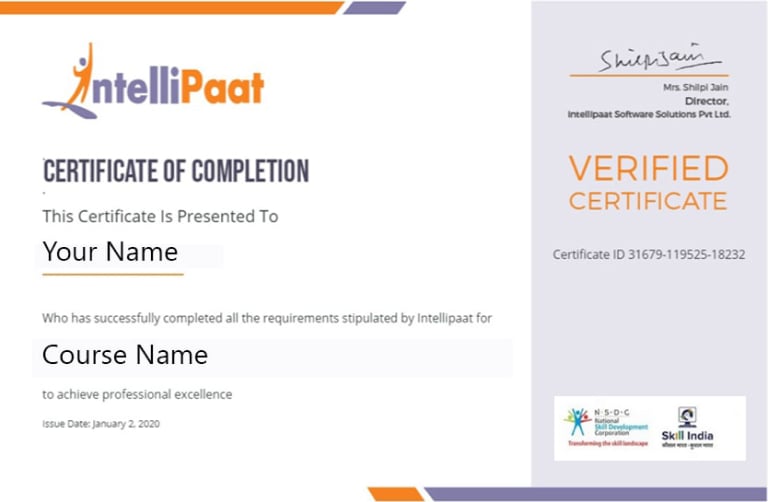
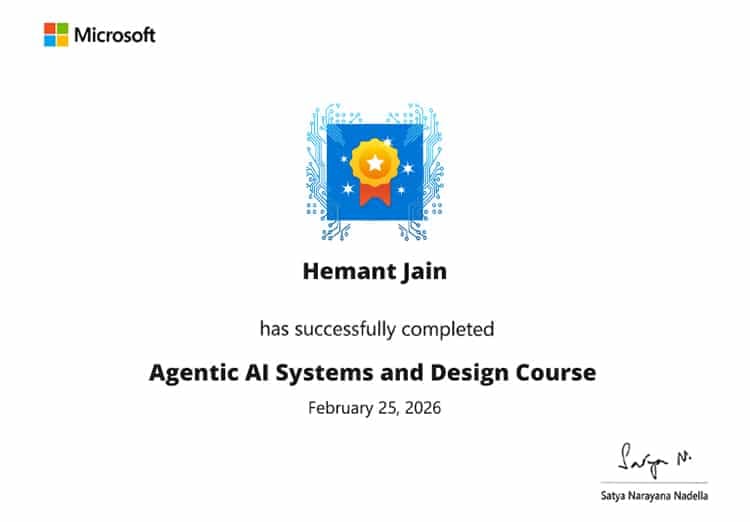
On successful completion of the modules in this course, learners will obtain a Agentic AI Systems and Design Certification. This Agentic AI Systems and Design Course Certification will ensure that the learners are industry-ready from Day 1.

This module builds a strong Python foundation required for modern AI and agentic system development.
Key Topics
This module introduces the core concepts behind agentic AI systems and how they differ from traditional AI applications.
Key Topics
A deep dive into the core building blocks that power intelligent, autonomous agents.
Key Topics
This module focuses on building, testing, and deploying practical single-agent systems.
Key Topics
This module explores how multiple agents collaborate to solve complex problems and how such systems are deployed in production.
Key Topics
A hands-on, end-to-end project focused on designing a production-grade agentic system.
Key Topics
This module bridges industry practice with cutting-edge academic research.
Key Topics
Agentic AI Systems
Modern Python 3.11+
Multi-Agent Orchestration
Retrieval-Augmented Generation (RAG)
CrewAI
AutoGen
LangGraph
DSPy
Function Calling
Advanced Prompt Engineering
Chain-of-Thought Reasoning
Asynchronous Programming
Pydantic and Data Validation
LLM Observability
Tool Integration
Model Context Protocol (MCP)
Memory Architectures
Vector Embeddings
System Design Patterns
Autonomous Workflows
Context-Augmented Generation (CAG)
Dependency Management
Low-Code Automation (n8n)
Ethical AI Guardrails
Graph-Based Workflows
Agentic AI Systems and Design Projects
Build an agent that browses the web, reads financial reports, analyzes stock trends using Python tools, and writes a comprehensive investment memo.
Create a multi-agent system using CrewAI where one agent scans resumes, another conducts initial screening questions, and a third schedules interviews.
Develop a RAG-powered agent with long-term memory that remembers past user interactions and can execute refunds via API.
A system of agents that researches trending topics, drafts articles, generates images, and optimizes SEO automatically.
Read More
Read More
Read More
Read More
This certification program caters to working professionals across industries. The learner diversity adds richness to class discussions and interactions.
Completed the Data Science & Artificial Intelligence – IITM Pravartak program from Intellipaat! Expert mentors, hands-on projects, and real-world case studies boosted my skills in ML, analytics, and data handling.
Read More
Curious about AI, I joined Intellipaat and completed projects like an ‘AI Chatbot’ for customer support. Now, I apply these skills to real-world projects, including predictive maintenance and customer segmentation.
I completed the course offered by Intellipaat, which had equipped me with knowledge in AI and ML. Now as an intern at Gnani.ai, I get the chance to implement concepts learned in real AI projects under industry experts.
Read More
Read More
To take the admission in this Agentic AI Systems and Design course, a simple 3-step process is to be followed. Only the candidates who will be shortlisted through this process can get admitted to the program.
A Gen AI course typically covers how to use LLMs to produce text or images (like ChatGPT). This Agentic AI course is a bit more advanced. It teaches you how to create Autonomous Agents that can plan, reason, use tools (like web search, coding, or APIs), and perform complex tasks without any human interaction. This course is geared towards developers who want to create production-grade systems, not just chatbots.
This program is best suited for Data Scientists, Python Developers, AI/ML Engineers, and Technical Architects looking for a skill upgrade. If you want to move beyond simple “prompt engineering” and build intelligent software that can solve problems autonomously, this course is for you.
The Era of “Prompt Engineering” is ending. The Era of “Agent Engineering” has begun. Companies are no longer looking for people who can just “chat” with ChatGPT. They need engineers who can build systems that work autonomously.
Yes, the basic knowledge of the Python programming language is necessary, as this is a technical course, and hands-on programming is necessary. Although we will be discussing Modern Python (3.11+) in Module 1, your prior programming experience with the Python language will give you a competitive advantage.
Yes, Intellipaat & Microsoft certificate is globally recognized . This will help you demonstrate your expertise in state-of-the-art technologies in AI and make you a specialist in Agentic Systems.
The program is offered in virtual live classes learning format. Your instructors are Industry experts, SME’s and IIT faculty.
To obtain the most out of this course, it is required that the candidates commit themselves to around 8-10 hours every week, which includes live sessions, reading, and hands-on labs and projects.
You will get 24/7 technical support and a learning portal. Moreover, you also get a facility for 1:1 sessions with Teaching Assistants (TAs) for doubt clearance and a forum with your peers to discuss your problems and share your insights.