


Chief Financial Officer (CFO) Course

  • Learn Financial Leadership from renowned IIM Ranchi faculty
  • Attend a 3-day campus immersion at IIM Ranchi
  • Master Financial Management, Valuation, Corporate Finance & Risk Management
  • Earn an Executive PG Certification & Executive Alumni Status
Recognitions
iim ranchi
Course Introduction
Next cohort Starts
26th July 2026
Live Online
Weekend Sessions
Course duration
10 Months

Key Highlights

120 Hours of Live Sessions from IIM Ranchi Faculty
10 Months of Live Sessions by IIM Faculty
Power BI Sessions by Industry Experts
Executive Post Graduate Certification from IIM Ranchi
3-Day Campus Immersion at IIM Ranchi
Executive Alumni Status from IIM Ranchi
Flexible EMI & Payment Options
24×7 Learner Support

Chief Financial Officer (CFO) Program Overview

Build expertise in Corporate Finance, Financial Management, Valuation, Capital Markets, Financial Analysis, Risk Management, Mergers & Acquisitions, and Strategic Financial Decision-Making through practical learning and real-world case studies.

CFOs play a critical role in driving financial strategy, business growth, and organizational performance. This program prepares professionals to lead financial planning, manage investment decisions, optimize capital allocation, and support long-term business success.

A Chief Financial Officer oversees an organization’s financial strategy, budgeting, risk management, and investment planning. CFOs manage financial performance, ensure regulatory compliance, support strategic decision-making, and drive sustainable business growth through effective financial leadership.

The program covers Corporate Finance, Financial Management, Capital Markets, Business Valuation, Financial Analytics, Risk Management, Mergers & Acquisitions, Corporate Governance, and Generative AI for Finance, complemented by live faculty sessions, industry projects, and a campus immersion at IIM Ranchi.

View More

Talk To Us

We are happy to help you 24/7

Meet Your Mentors

IIM Ranchi Chief Financial Officer (CFO) Certification

  • Industry-recognized Executive Post Graduate Certification from IIM Ranchi
  • Develop practical skills in Corporate Finance, Valuation, Capital Markets, Risk Management & Financial Leadership
  • Placement support with 3100+ Hiring Partners, including leading MNCs and global enterprises
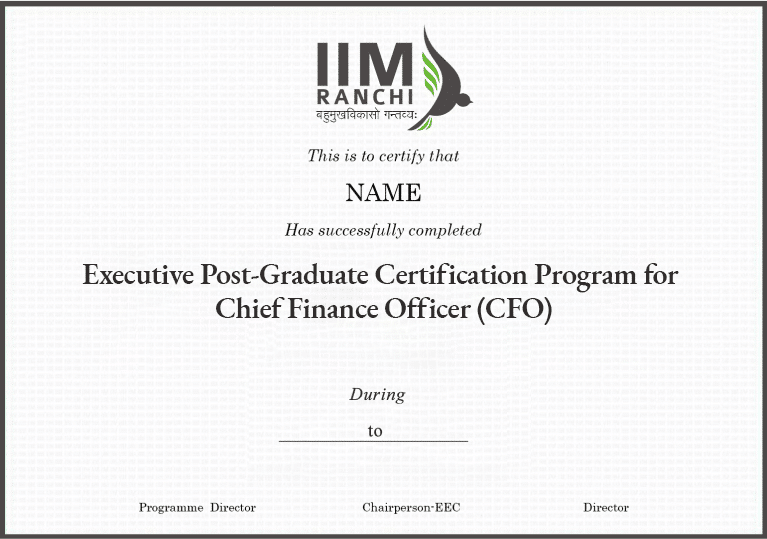
EPGC Program for Chief Finance Officer Certificate
IIM Ranchi
View Certificate

Curriculum

Live Course

Phase 1: Business Management Foundations

  • Understand managerial economics general foundations and discuss demand analysis & forecasting.
  • Explore the concepts of cost, demand, and product pricing strategies. Learn about the market structure and profit maximization.
  • Learn about accounting concepts, principles, and conventions. Understand how to analyze financial statements and draw insights from them.
  • Discuss the basics of financial management and cost-volume-profit analysis and understand what capital budgeting is.
  • Understand international accounting and explore the concept of IFRS and risk management.
  • Get introduced to the organizational behaviour, elements, and levels of organisational behaviour.
  • Understand the significance of organizational culture and discuss the HR management strategies and planning.
  • Discuss and analyse job trends, recruitment strategies, and labour market dynamics.
  • Explore the strategies for organisational learning, employee development, performance management, and retention.
  • Discuss the key operations concept in supply chain management, such as cycle time, throughput, and work-in-progress, and also understand the process structure in services and manufacturing.
  • Learn to perform process analysis and do resource planning & scheduling.
  • Understand the meaning of lean management, logistics management, and the significance of supplier relationship management.
  • Get introduced to strategic management, discuss environmental scanning, and analyse industry trends.
  • Learn to make internal and external growth strategies and explore how to manage turnaround leadership and change management.
  • Discuss key business strategies and get an understanding of entrepreneurship & intrapreneurship.
  • Describe what product management is and the key pricing strategies.
  • Discuss various advertising and sales promotion strategies and explore distribution strategies in marketing and sales management.
  • Analyse the branding strategies, customer relationship management practices, digital marketing, and social media marketing techniques.

Phase 2: Financial Markets & Investment Management

  • Exploring financial innovations and different types of markets
  • Illustrate the participants in the market and framework of the regulatory bodies
  • How to perform Portfolio Investment and Diversification
  • Identify the types of financing needs and explore the various stages of business along with their corresponding financing sources.
  • Understand the concepts of financing startups and private equity and delve into the functioning of Public Investment in Private Equities (PIPEs).
  • Define public issues and illustrate the functions of secondary market operations.
  • Explore derivative products and markets and classify the role of derivatives and synthetics in financial management.
  • Understand the concepts and basics of statistics and learn how to apply central tendency and variation effectively.
  • Implement the concepts of variance and standard deviation and apply covariance and correlation in statistical analysis.
  • Understand regression and explore the function and importance of Excel fundamentals in data analysis.
  • Calculate risk-return using Modern Portfolio Theory, explore asset pricing, and illustrate the functions of CAPM (Capital Asset Pricing Model) and APT (Arbitrage Pricing Theory).
  • Perform the analysis of financial statements and gain an understanding of market data for informed decision-making.
  • Identify the primary data sources and illustrate the roles of analysts, speculators, and arbitrageurs in financial markets.
  • Understand the concepts of disclosure and transparency and explore how corporate governance works to ensure accountability and ethical practices.
  • Explore the types of FIS (Financial Information Systems) markets and define the regulations that govern them.
  • Explore the various money market instruments and understand corporate and government bond market functions.
  • Learn how to calculate FIS (Financial Information Systems) valuation and study the key concepts of bond mathematics.
  • Calculate the yield curve and research FIS (Financial Information Systems) risk management strategies.
  • Learn how to use standards and premises and explore the concept of DDM.
  • Deduce the DCF (Discounted Cash Flow) valuation, analyse the adjusted present value, and calculate the relative equity valuation.
  • Identify the enterprise value and calculate the asset-based valuation.
  • Find the contingent claim valuation and illustrate the key concepts of mergers and acquisitions.
  • Understand the limits to diversification and get an overview of the emergence of the multi-asset market.
  • Compare the differences between personal and professional investment and illustrate the concepts of an investment policy statement.
  • Illustrate the concepts of investment styles, define asset allocation, and understand the workings of screening and index development.
  • Compare the differences between passive and active investments, learn how to use optimization, and perform backtesting to assess investment strategies.
  • Examine portfolio analysis and deduce performance analysis to evaluate the effectiveness of investment strategies.

Phase 3: Strategic Financial Leadership

  • Get introduced to mergers and acquisitions (M&A) and explore its various types.
  • Compare friendly and hostile takeovers and provide an overview of the M&A process.
  • Explore the valuation methods used in M&A, understand post-merger management strategies, and examine the risks and challenges associated with M&A.
  • Get an overview of the IPO and explore its detailed process and timeline, including the steps from preparation to market debut.
  • Explore the methods of valuing a company for an IPO and analyse the strategic choice between M&A and IPO.
  • Case Study: Disney’s Acquisition of 21st Century Fox
  • Learn data-driven decision-making and explore types of financial data and sources.
  • Understand the democratization of data across upstream and downstream processes and explore finance data collection methods, including transactional, operational, and market data.
  • Explore data analysis tools for finance, understand key financial metrics for decision-making, and learn to calculate profitability, liquidity, and solvency ratios.
  • Identify financial risks, explore risk frameworks like VaR and scenario analysis, and use statistical models for assessment.
  • Create and interpret financial scenarios, develop data-driven risk mitigation strategies, and explore hedging techniques like derivatives and options.
  • Explore strategic thinking for finance leaders and differentiate between strategic and operational approaches in financial management.
  • Understand long-term financial planning, vision and explore the role of key performance indicators (KPIs) in strategies.
  • Identify and mitigate long-term financial risks while making strategic capital budgeting decisions to ensure sustainable growth.
  • Understand the definition and importance of corporate governance, explore key principles of governance frameworks, and examine the role of the CFO in ensuring effective corporate governance.
  • Explore governance structures, including the board of directors and committees, and compare governance models across public and private companies.
  • Understand regulatory and compliance frameworks and explore the role of risk management and internal controls in ensuring organizational integrity.
  • Examine the CFO’s role in board decision-making and strategic discussions, understand the impact of ethical leadership on corporate culture, and explore strategies for building and maintaining stakeholder trust.
  • Explore sustainability and corporate social responsibility (CSR), understand crisis management and ethical decision-making, and examine how governance can combat fraud and corruption.

Phase 4: AI, Business Intelligence & Executive Leadership

  • Understand what Generative AI is, explore the concept of prompt engineering, and learn about the role of Generative AI in transforming the finance industry.
  • Explore how artificial intelligence is reshaping business models, learn how generative AI is used for predictive financial modelling, and understand its role in enhancing the accuracy of revenue and expense forecasting.
  • Examine AI-driven risk analysis and scenario generation and discover how AI detects financial anomalies and fraudulent activities.
  • Explore Power BI basics, dive into data modelling and DAX, including Time Intelligence functions and advanced DAX features, and understand the use of slicers and filters.
  • Understand Power BI Query, Q&A, and data insights features for practical data analysis. Learn about Power BI settings, administration, and direct connectivity.
  • Explore Embedded Power BI API, Power BI Mobile, and advanced features in Power BI Premium for enhanced performance and scalability.
  • Strategic Leadership
  • Digital Transformation and Design Thinking
  • Legal issues
  • Master Effective Job Search Strategies and Resume Building Techniques.
  • Receive Mentorship Support for LinkedIn Profile Creation.
  • Participate in Interview Preparation Sessions with Industry Experts.
  • Mock Interviews for Better Interview Readiness.
View More
Disclaimer
Intellipaat reserves the right to modify, amend or change the structure of module & the curriculum, after due consensus with the university/certification partner.
Skills to Master

Financial Planning and Analysis

Budgeting and Forecasting Techniques

Strategic Financial Management

Cash Flow Management

Risk Management

Mitigation Strategies

Investment Decision-Making

Cost Management and Control

Mergers and Acquisitions (M&A) Strategies

Performance Analysis

Capital Management

Crisis Management

View 9 more Skills

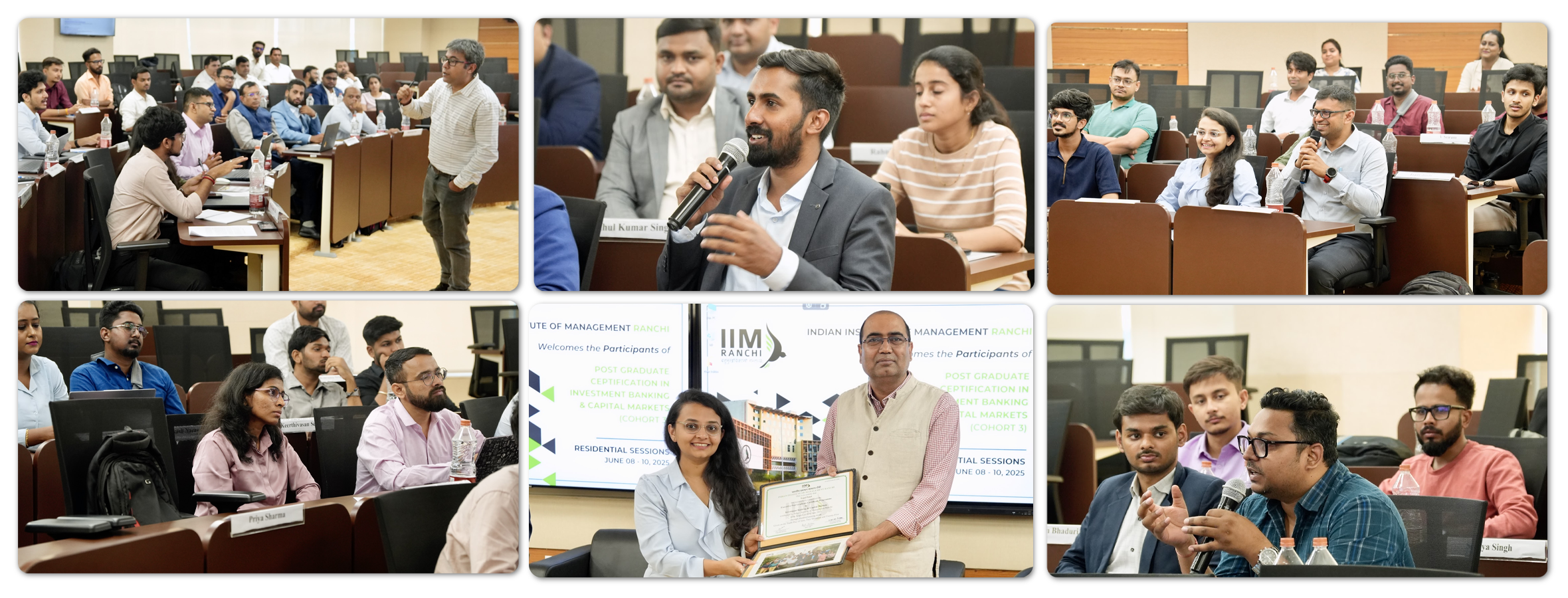
Experience Immersive Learning at the IIM Ranchi Campus

Campus immersion experience Desktop Image Campus immersion experience Mobile Image

Admission Process

To take the admission in this course, a simple 3-step process is to be followed. Only the candidates who will be shortlisted through this process can get admitted to the program.

STEP 1
Submit Application
Speak to the course advisor and mention your career goals & interest for this Chief Financial Officer program.
STEP 2
Application Review
Our team will review your application based on your interest and experience.
STEP 3
Admission
Shortlisted candidates can confirm their seats by paying the course fees.
Who should apply for this Chief Financial Officer Training?
To ensure we are able to give you the best possible outcome from this program, we check for the following things:
  • A completed bachelor’s degree with a minimum of 50% marks
  • Basic proficiency in listening and reading English
  • Anyone with keen interest in learning Chief Financial Officer

Program Fee & Financing

Total Fee
₹1,99,044
(Inclusive of taxes)
We partnered with financing companies to provide very competitive finance options at 0% interest rate
dk-fee-emi-logo
Admission Closes On:
26th July 2026
Apply Now

Program Cohorts

Next Cohorts

Date Time Batch Type
Program Induction 26th July 2026 09:00 AM - 12:15 PM IST Every Sunday
Regular Classes 26th July 2026 09:00 AM - 12:15 PM IST Every Sunday
Apply Now

Frequently Asked Questions

Program

How will I receive my certificate upon completion of the CFO course?

Upon program completion, you will receive an Executive Post Graduate Certification in the Chief Finance Officer from IIM Ranchi. Please find below the criteria for receiving the certificate.

  • The participants who meet the academic requirements and the minimum attendance criteria will receive a course completion certificate.
  • The participants who do not meet the defined evaluation criteria but have the minimum attendance will receive a participation certificate.
  • The participants who fail to meet both the evaluation and minimum attendance criteria will not receive any certificate.

By enrolling in this CFO program, you will receive world-class training in collaboration with IIM Ranchi. The sessions are conducted by the experienced professors of IIM Ranchi through live interactive classes. In this training, you will get hands-on experience and master the essential finance skills, which will prepare you for leadership roles in the industry.

Upon completing this course and submitting all the capstone projects and assignments, you will receive an industry-recognized post-graduate certificate in Chief Finance Officer from IIM Ranchi.

All live sessions are recorded, and the recordings are available for access within 12 hours of session. In case you miss any class, you can watch the recording of the session from the dedicated learning platform (Intellipaat LMS).

To receive executive alumni status, you must pay a fee of Rs. 10,000 (inclusive of all charges) in full to IIM Ranchi upon completing the program.

  • On the portal, you will receive regular newsletters, important news, articles about the Institute, and updates on achievements, events, and programs.
  • As an Executive Education Alumni, you will receive a 5% discount on program fees if you choose to enrol in another LDP.

Please note that the course fees are non-refundable. We will support you at every step to meet your upskilling and professional growth needs.

Yes, IIM Ranchi certification is widely recognized and valued in the industry, and this CFO course is designed to meet industry trends and demands. Many of the IIM Ranchi alumni work in the world’s top MNCs and startups at top levels.

In this CFO course, you will master the following key skills:

  • You will learn corporate finance strategies, including capital allocation and investment planning.
  • You will also learn about optimal liquidity and understand how to manage working capital.
  • You will learn to evaluate, negotiate, and execute mergers and acquisitions.
  • You will learn about tax laws, how corporate tax planning is done, and compliance management.
  • Learn Power BI to perform data visualization.

This CFO program by IIM Ranchi consists of over 20+ specialized CFO courses:

  1. Managerial Economics
  2. Accounting and Financial Management
  3. Organizational Behavior and Human Resources Management
  4. Operations and Supply Chain Management
  5. Strategic Management and Organizational Excellence
  6. Marketing Management
  7. Innovations of Financial Markets and Various Forms of Business in the Organization
  8. Deep Dive into Business Capital and the Workings of the Primary and Secondary Capital Markets
  9. Overview of Quantitative and Computational Techniques for Capital Markets
  10. Outline the Financial Information from Sources and Intelligence
  11. Overview of the Fixed Income Market and Regulatory Environment
  12. Learn Concepts of Equity Valuation, Business Valuation & Strategic Investments
  13. Performing Diversification in Portfolios and Investments
  14. Mergers, Acquisitions, and IPO
  15. Data-Driven Decision Making/Risk Management Strategies
  16. Strategic Thinking for CFOs
  17. Corporate Governance and Ethical Leadership
  18. Gen AI for Finance
  19. Power BI
  20. In-Campus Module
  21. Job Readiness

This comprehensive curriculum is designed to equip aspiring CFOs and senior finance professionals with modern, industry-relevant capabilities.

This career offers the opportunity to lead financial strategy and make key financial decisions for an organization as a Chief Financial Officer. It is a rewarding path that combines leadership, analytical expertise, and strategic vision to drive business growth. This CFO course offers a strong learning experience that prepares aspiring CFOs and experienced senior finance professionals to advance into top leadership roles. It also offers an attractive salary.

According to Glassdoor, CFOs in India earn between INR 15,00,000 and INR 57,00,000 a year, with an average annual salary of INR 37,00,000.

A CFO manages the company’s finance department and plays a crucial role in making strategic financial decisions. They handle budgets, cash flow, and forecasts. They are also responsible for making investment-related decisions, assessing financial risks, and ensuring everything follows the rules and regulations.

View More