






























Your cart is currently empty.


Technology Manager | Cognizant
Intellipaat’s Investment Banking program helped me switch from a Tech Lead to a Finance Analyst role and provided me with a better understanding of business and positive recognition for my contributions.
Senior Application Developer
Technology Manager

SecOps in Investment Banking | Wells Fargo
Intellipaat’s investment banking program supported my professional development at Wells Fargo and helped me transition into investment banking by putting my project management, financial, and leadership skills into practice.
SecOps in the Mortgage Department
SecOps in Investment Banking

Senior Management Role | HDFC Life
With practical learning, expert guidance, and continuous support from Intellipaat, I upgraded my financial and managerial skills, secured a senior management role, and achieved an impressive 70% increase in my current CTC.
Management Role
Senior Management Role

Client Data Specialist | J.P. Morgan
My transition from ICICI to a KYC Client Data Specialist at JP Morgan was made possible by the knowledge and practical experience I gained from this online Investment Banking certification course.
Deputy Manager
Client Data Specialist

Senior Analyst | Deutsche Bank
I was able to transition from a contract role to a Senior Analyst while pursuing Investment Banking and Capital Markets at Intellipaat, and I got an amazing hike of 54% with the upskilling journey.
Contract Role
Senior Analyst

Associate | Blenheim Chalcot
Read More
Team Member
Associate
60% Average Salary Hike
$1,30,000 Highest Salary
50 LPA Highest Salary
11000+ Career Transitions
3100+ Hiring Partners
Career Transition Handbook
The Executive Programme in Financial Analysis with AI by IIM Raipur develops practical skills in financial statement analysis, FP&A, budgeting, forecasting, financial modelling, valuation, and financial risk. Through case studies, industry sessions, hands-on projects, Excel, Power BI, and Generative AI, participants learn to turn financial data into actionable business insights.
Online Instructor-led Interactive Sessions:
Module 1: Understanding Financial Statements & Business Economics
Module 2: Financial Statement Analysis & Business Performance
Module 3: Cost, Profitability & Managerial Financial Analysis
Module 4: FP&A – Budgeting, Forecasting & Performance Management
Module 5: Financial Modelling & Scenario Analysis
Module 6: Corporate Finance, Investment Decisions & Business Valuation
Module 7: Financial Risk, Governance & Quality of Earnings
Module 8: AI-Powered Financial Analysis & Decision-Making
Additionally, this Financial Analysis programme includes industry expert sessions, practical financial modelling, FP&A and valuation exercises, finance dashboards, and an AI Finance Lab to develop practical financial analysis and decision-making skills.
The programme aims to develop practical financial analysis capabilities for evaluating business performance, forecasting financial outcomes, building financial models, assessing business value, identifying financial risks, and supporting management decisions.
You will develop skills in financial statement analysis, profitability analysis, FP&A, budgeting, forecasting, financial modelling, scenario analysis, business valuation, risk analysis, Excel, Power BI, and Generative AI for finance.
Financial analysis skills can support opportunities across financial analysis, FP&A, corporate finance, business finance, management reporting, financial planning, and related roles. The programme also develops capabilities relevant to AI-enabled finance functions.
Talk To Us
We are happy to help you 24/7
Prof. Varsha Mamidi is an Associate Professor of Information Systems at IIM Raipur. She holds a PhD in IT & Finance from Monash University and has tech industry experience across Australia, India, and the UK, focusing on AI/ML and blockchain.
Prof. Jagannath MVK is an Assistant Professor at IIM Raipur with a PhD from IIM Indore. A qualified CMA and CS, he spent 9 years in banking. His research covers bankruptcy, financial distress, banking institutions, and governance.
Participants build a financial model using actual company data covering:
Hands-on workflows for:
A senior finance practitioner discusses:
Financial Statement Analysis
Business Performance Analysis
Financial Analysis
FP&A
Budgeting & Forecasting
Financial Modelling
Scenario & Sensitivity Analysis
Business Valuation
Profitability Analysis
Financial Risk Analysis
Quality of Earnings Analysis
Management Reporting
Generative AI for Finance
Power BI Dashboards
Excel for Financial Analysis
AI-Powered Financial Analysis
Projects
Analyse a listed company across profitability, liquidity, efficiency, leverage, cash flow, ROE, ROCE and key risks to create a comprehensive financial health report.
Compare actual and budget data to identify revenue, cost, margin, and profitability variances and recommend corrective actions through a CFO-style review.
Build a financial forecast model using business drivers, revenue, costs, profit, cash flow and Base, Optimistic and Downside scenarios to support business decisions.
Value a listed company using Discounted Cash Flow, Comparable Companies and financial multiples, linking business performance to valuation and developing a recommendation.
Analyze historical financials, forecast performance, assess risks, benchmark competitors, and use Generative AI to generate insights for CFO-level decisions.
Build a finance dashboard using revenue, profitability, budget, variance and KPI data to present business performance and generate actionable management insights.
Use Generative AI to analyze annual reports, financial statements, competitors and management commentary to develop forward-looking financial recommendations.
To take the admission in this course, a simple 3-step process is to be followed. Only the candidates who will be shortlisted through this process can get admitted to the program.
| Date | Time | Batch Type | |
|---|---|---|---|
| Program Induction | 1st Nov 2026 | 12:30 PM - 4:15 PM IST | Every Sunday |
Financial analysis involves evaluating financial statements, business performance, profitability, cash flow, risks and other financial information to support informed business and management decisions.
The programme covers financial statements, financial statement analysis, managerial financial analysis, FP&A, budgeting, forecasting, financial modelling, valuation, financial risk, governance and AI-powered financial analysis.
Financial analysis skills are relevant across finance functions including financial analysis, FP&A, corporate finance, business finance, management reporting and financial planning. The programme also covers AI-enabled finance practices.
A financial analyst evaluates financial statements, business performance, profitability, cash flow, risks and forecasts. Financial analysts use these insights to support planning, investment evaluation and management decision-making.
You will develop skills in financial statement analysis, profitability analysis, FP&A, budgeting, forecasting, financial modelling, valuation, risk analysis, management reporting, Excel, Power BI and Generative AI for finance.
An MBA is not specified as a requirement for this programme. The curriculum provides structured learning across financial analysis, FP&A, financial modelling, valuation, risk management and AI-powered financial decision-making.
The industry-led curriculum includes Advanced Excel for Financial Analysis and Power BI for Finance Dashboards. The programme also covers Generative AI and LLMs for financial analysis and decision-making.
The Executive Programme in Financial Analysis with AI has a duration of 6 months and is delivered through live online sessions every Sunday for 3 hours.
The programme includes 60 hours of faculty-led learning by IIM Raipur and 40 hours of industry and applied sessions facilitated by Intellipaat, for a total of 80 learning hours.
The programme includes projects covering financial health analysis, FP&A and variance analysis, financial modelling and forecasting, business valuation, and an AI-powered CFO analysis capstone.
Yes. The programme includes budgeting, revenue and expense forecasting, variance analysis, Price-Volume-Mix analysis, KPI monitoring, dashboards, management reporting and Monthly Business Reviews.
Yes. The programme covers Generative AI and LLMs for finance, including AI-assisted financial statement analysis, annual report analysis, forecasting, valuation, competitor benchmarking, financial research and management reporting.
Yes. Industry-led sessions include Advanced Excel for Financial Analysis and Power BI & Finance Dashboards, covering financial analysis, scenario analysis, sensitivity tables, KPI tracking and management reporting.
No. Campus immersion is not applicable to this programme.
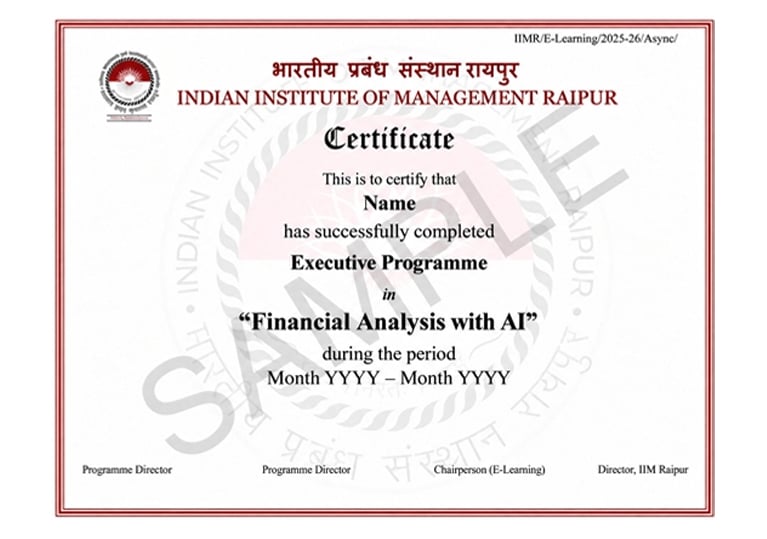
Yes. Participants are eligible for the programme certificate upon successful completion of the programme.
No. Alumni status is not applicable to this programme.
The programme fee is ₹70,000.
Financial analysis skills can support roles and opportunities across financial analysis, FP&A, corporate finance, business finance, financial planning, management reporting and related finance functions. Career outcomes depend on individual qualifications, experience and hiring requirements.
Yes, we offer flexible EMI options to suit your budget:
No-Cost EMI up to 9 months – Pay in easy monthly installments with zero additional interest.
12-Month EMI – Available with an additional charge of ₹5,000.
24-Month EMI – Available with an additional charge of ₹11,000.
Choose the plan that works best for you and start learning without financial stress!
Before the commencement of the IIM faculty-led sessions, Intellipaat will conduct Phase 0: Industry Expertise & Applied Learning, comprising 40+ hours of industry-focused Pre-Master’s training. This phase is designed to build foundational knowledge and practical skills relevant to finance, financial analysis, and management.
The phase will cover the following industry-focused masterclasses:
Upon completion of this 40+ hour Pre-Master’s phase, learners will proceed to the IIM faculty-led academic sessions.