All Courses
×
IIM Ranchi

Product Management Course - IIM Ranchi Programme

4,233 Ratings

Executive Post Graduate Certification in Product Management Programme by Top Ranked IIM

  • Learn Product Management from IIM Ranchi faculty and top industry experts
  • Attend a 3-day campus immersion at IIM Ranchi
  • Gain executive alumni status from IIM Ranchi
  • Earn a prestigious Product Management certification from IIM Ranchi
  • Receive 3 guaranteed interview opportunities through the placement pool
iim ranchi
Course Introduction

Watch

Course Preview

Key Highlights

30+ Hours of PreMaster's classes by Industry expert
120 Hours of IIM Ranchi Faculty led training
No-cost EMI Option
Post Graduate certificate from IIM Ranchi
Career Services from Intellipaat
Resume & LinkedIn profile enhancement
24×7 lifetime access to learning & support
Google-Reviews 3109
sitejabber 1493
mouthshut 24542

Product Management Course Overview

What skills will you master in this product management course by IIM Ranchi?

In this product management course by IIM Ranchi, you will learn these skills:

MS Excel: Analyze data and create insightful reports using advanced functions and pivot tables.

Figma: Design user interfaces and prototypes for user-centered products.

Jira: Manage agile projects by tracking tasks, backlogs, and sprints efficiently.

Google Analytics: Analyze user behavior to optimize product strategies and improve user experience.

Product Strategy Development: Create effective strategies by understanding market needs and competition.

User Research and Testing: Gather feedback through user interviews and usability testing.

Agile Methodologies: Apply Scrum and Kanban for flexible and collaborative product development.

Here are a few reasons why you should pursue a career in product management:

Opportunity to Drive Impactful Change: Product managers guide product strategy, aligning business objectives with user needs and creating tangible impacts on company success​.

Competitive Salary: In India, the average salary of an experienced product manager ranges between INR 20-30 lakh annually, whereas in the US, they earn around $12,00,000 annually.

High Demand and Career Growth: LinkedIn shows more than 18,000 jobs are available in India and more than 1,39,000 in the US.

Access to Various Technology: Work with Excel, and data analytics, staying at the forefront of digital innovation​.

A product manager is responsible for guiding a product from idea to launch. They work with marketing, engineering, and design teams to understand customer needs, define product features, and ensure everything aligns with the company’s goals.

There are 25+ courses in this product management program, with multiple real-world case studies and industry-oriented projects.

Course 1: Preparatory sessions on Excel for Data Analytics

Course 2: Introduction to the Project Management tool – Jira

Course 3: Introduction to Figma for UX Design

Course 4: Introduction to Product Strategy & Management

Course 5: Product Life Cycle and Strategy

Course 6: Strategic Market Analysis

Course 7: Product Ideation and Validation

Course 8: Customer-Centric Product Design & Prototyping

Course 9: Competitive Advantage in Product Strategy

Course 10: Product Engineering Strategies

Course 11: Product Launch & Go-To-Market (GTM) Strategies

Course 12: Competitive Strategies and Market Positioning

Course 13: Branding & Product Positioning

Course 14: Product Pricing Strategies

Course 15: Growth Strategies and Competitive Edge

Course 16: Disruptive Innovation & Strategic Planning

Course 17: Product Analytics & its Importance

Course 18: Product Analytics Process

Course 19: Metrics and Goals in Product Analytics

Course 20: Data Cleaning, Coding, and Preparation

Course 21: Descriptive Analytics for Product Management

Course 22: Predictive Analytics for Product Management

Course 23: Analysis for New Product Development

Course 24: Consumer Behavior Analysis

Course 25: Digital Analytics: Tools and Techniques

Course 26: Product Promotion in Digital Space

Course 27: Product Distribution & Support

Course 28: Innovative Communication and Storytelling

Course 29: Strategic Business Case Studies

 

View More

Talk To Us

We are happy to help you 24/7

Career Transition

55% Average Salary Hike

$1,30,000 Highest Salary

45 LPA Highest Salary

12000+ Career Transitions

300+ Hiring Partners

Career Transition Handbook

*Past record is no guarantee of future job prospects

Meet Your Mentors

What Roles Can a Product Management Professional Play?

Product Owner

Product owners are responsible for maximizing a product’s value by providing insights on how it can be improved.

Product Manager

They manage the entire product development lifecycle, create a product strategy and roadmap, and work with cross-functional teams, such as marketing and business analysts.

Technical Product Manager

They manage the technical aspects of a product. They mainly work with engineering teams and have a strong technical background.

Product Marketing Manager

They develop strategies for positioning the product, launching it, and generating market demand. They also conduct customer research and provide insights into the product.

Growth Product Manager

They specialize in improving customer acquisition, user retention, and monetization. Their job is to make strategies to improve customer engagement.

View More

Skills to Master

Product Design

Product Planning

Market Research and Strategy

Data Cleaning

Data Analytics

Stakeholder Management

Prototyping

Product Experimentation

Artificial Intelligence

Machine Learning

Usability Testing

Agile Development

Pricing Strategy

User Retention

View More

Tools to Master

Jira Trello Aha figma Google Analytics 1 chatgpt Deepseek 1 miro agile

Course Fees

Online Classroom Preferred

(Every Sunday)

20 Jun 2026 12:30 PM - 04:15 PM
(Every Sunday)

27 Jun 2026 12:30 PM - 04:15 PM
(Every Sunday)

04 Jul 2026 12:30 PM - 04:15 PM
(Every Sunday)

11 Jul 2026 12:30 PM - 04:15 PM
$2983 10% OFF Expires in

Corporate Training

  • Customized Learning
  • Enterprise Grade Learning Management System (LMS)
  • 24x7 Support
  • Enterprise Grade Reporting

Contact Us

Curriculum

Live Course Industry Expert Academic Faculty

Prerequisite Sessions (Intellipaat)

  • Effectively using MS Excel
  • Working with Jira
  • Mastering Figma for UX
Download Brochure

Phase 1: Foundations of Product Management

  • Define what a Product Is, and discuss its various types and key features.
  • Discuss product mix, product lines, along with product life cycle.
  • Understand the role of product management within an organisation and explore the critical success drivers in product management.
  • Learn the basics of consumer research and how it connects with data-driven decision-making.
Download Brochure
  • Describe product strategy and its characteristics, and explain product managers’ pivotal role in strategy formulation.
  • Discuss the importance of market research in strategy development and understand the key frameworks for product strategy, such as Ansoff’s Matrix and BCG.
  • Learn how to drive strategic planning, implementation, and control processes to align product goals with business objectives.
Download Brochure
  • Discuss the 5C Framework, explore the Buy, Build, or Partner decision framework, and learn key market segmentation and analysis techniques.
  • Understand prelim Business Model Canvas, and also learn SWOT analysis for market insights.
  • Explore industry competitiveness through Porter’s Five Forces framework.
Download Brochure
  • Understand the value creation in product development, value proposition design, and mapping. Also, explore strategies for value communication.
  • Discuss the difference between traditional and contemporary value delivery models and the importance of co-creation and customer involvement.
  • Describe Porter’s Value Chain and its applications, and also discuss how to align product features with customer needs.
Download Brochure

Phase 2: Product Ideation and Design

  • Discuss Innovation and its importance. Learn idea-generation techniques like Brainstorming and SCAMPER.
  • Learn about idea validation, the screening process and how to develop a minimum viable product.
  • Explore what intellectual property is, along with a business model canvas for product ideation.
Download Brochure
  • Understand buyer persona mapping and its importance.
  • Discuss the design thinking process and its applications and explore low-fidelity prototyping techniques.
  • Understand user experience design principles, interaction design, and prototyping tools. Also, learn how to create customer journey mapping for problem-solving.
Download Brochure
  • Define product strategy and its core competencies, such as Identifying and leveraging strengths.
  • Understand how to build Strategic Business units (SBUs) and how to make competitive strategies for product positioning.
  • Learn how to align strategy with market needs and gaps.
Download Brochure

Phase 3: Strategy and Market Execution

  • Describe the prototype development methods, tools, testing, and validation.
  • Learn about Agile methodology and Scrum.
  • Explore various feature prioritisation techniques like MoSCow and Kano and learn how to integrate continuous feedback into development.
Download Brochure
  • Understand go-to-market strategy, test marketing, its purpose, and implementation. Also,  explore the steps to develop and execute a GTM plan.
  • Learn about the timing and execution of a product launch strategy. Also, explore the adoption and diffusion of innovations.
  • Understand how to manage product launches with agile frameworks.
Download Brochure
  • Learn the difference between Market Orientation and Competitor Orientation, and understand the concept of product positioning and its best practices.
  • Define Points of Parity (POP) and Points of Difference (POD) and understand how to use messaging frameworks for product success.
  • Learn about the competitive strategy for emerging markets and how to refine positioning using market trends.
Download Brochure

Phase 4: Advanced Product Development and Analytics

  • Understand the basics of branding and how to build a strong brand identity.
  • Learn to develop brand equity, designing a brand positioning and brand architecture.
  • Understand the concept of brand mapping and building brand perception with visual and verbal identity in competitive markets.
Download Brochure
  • Learn about product pricing strategies, understand the reference and psychological pricing methods, and explore cost’s role in pricing decisions.
  • Understand what value-based pricing, price sensitivity, price wars, and ethics in pricing are.
Download Brochure
  • Describe the market opportunity analysis and tapping untapped markets, exploring rural and niche segments.
  • Learn about B2B product management, its key differences, and strategies. Also, implement beta programs for product refinement.
  • Define customer acquisition and retention tactics and how to scale products for market leadership.
Download Brochure

Phase 5: Analytics and Metrics

  • Understand the disruptive innovation models and characteristics of disruptive products. Learn to map innovation in established markets.
  • Learn how to overcome status quo bias in customers and bridge the strategic gap with innovation.
  • Explore strategic planning for disruptive products and the risks involved.
Download Brochure
  • Understand the meaning of product analytics and its role and explore how it is applied to decision-making.
  • Learn about the characteristics of high-quality analytics and various scientific methods for product analytics. Then, use analytics to identify the market gap.
Download Brochure
  • Get an overview of exploratory, descriptive, and casual analytics and learn about direct exploratory methods, such as Focus Groups and in-depth Interviews.
  • Learn about indirect exploratory and observation methods in product development and integrating analytics into product strategy.
Download Brochure
  • Describe various measurement and scaling techniques and understand the difference between Discrete and continuous measurement scales.
  • Learn how to ensure reliability and validity in data collection and design questionnaires for product research.
  • Explore different data collection techniques for product metrics.
Download Brochure
  • Understand data preparation techniques and how to handle missing values using imputation techniques.
  • Learn what data coding is and how to arrange data for suitable analysis. You can also explore secondary data analytics and gather insights.
  • Learn about various survey analytics techniques and analyse data for product development insights.
Download Brochure
  • Explain what descriptive analytics is and understand its application in product decisions.
  • Perform correlation analysis for identifying product trends and hypothesis testing.
  • Describe the P-value/Significance value method for product insights. Discuss the common errors in testing and ways to avoid them.
Download Brochure
  • Discuss the difference between descriptive and predictive analytics, and explore how data can be used for predictive modeling.
  • Learn to build and test various regression models while discussing their assumptions and limitations.
Download Brochure

Phase 6: Deep Dive in Advanced Product Management and Capstone Project

  • Discuss various reasons for applying analytics in product development. Learn conjoint analysis and understand the conjoint study process using Microsoft Excel.
  • Calculate the importance of product features and validate a conjoint model for market fit.
  • Explain the process of calculating market share for new products and demonstrate conjoint data analysis using XLSTAT.
Download Brochure
  • Discuss the importance of consumer behaviour in product management and the factors affecting it.
  • Understand customer research using techniques like factor analysis and discuss the principle component of factor analysis for product insights.
  • Demonstrate factor rotation for behaviour insights. Learn to create new product insights and explore the application of consumer analytics in market segmentation.
Download Brochure
  • Discuss Web analytics and its importance, and learn about A/B testing with the demo.
  • Understand the customer basket analysis for cross-selling and lifetime value analysis for product retention.
  • Explore digital product analytics tools and perform real-time web analytics for product optimisation.
  • Learn to build effective dashboards for digital products.
Download Brochure
  • Discuss what digital marketing funnel and various display advertising techniques are, along with their best practices and principles.
  • Understand what Search Engine Marketing is and how to make social media marketing strategies for products. Discuss Facebook and LinkedIn marketing strategies with differences and applications.
  • Learn conversion optimisation and how to improve ROI for digital ads. Also, understand how to measure campaign effectiveness with analytics.
Download Brochure
  • Discuss the channels of distribution and the difference between direct and indirect channels.
  • Understand the importance of product packaging and how to develop a distribution network for product reach.
  • Understand the role of customer support in the product lifecycle and various service strategies for product growth. Learn how to handle product discontinuation, returns, and refunds.
Download Brochure
  • Understand the role of storytelling in product management and developing persuasive messaging for product success.
  • Learn how to communicate through data visualisation and also understand the basics of visual storytelling for product promotion.
  • Explore various storytelling tools and use them to improve customer engagement.
Download Brochure
  • Google & Fitbit: Merging Data with Wearable Technology
    Analyse Google’s acquisition of Fitbit and its strategic implications for expanding into the health and fitness market.
  • Microsoft & LinkedIn: Integrating Professional Networks
    Examine Microsoft’s acquisition of LinkedIn and how it leverages the integration to enhance its enterprise solutions.
  • Uber & Postmates: Expanding Delivery Services
    Investigate Uber’s acquisition of Postmates and the strategic benefits of expanding its delivery services portfolio.
  • Salesforce & Slack: Transforming Business Communication
    Understand Salesforce’s acquisition of Slack and its strategy to enhance collaboration and integrate with its CRM offerings.
Download Brochure
  • Learn the use of Agentic AI and Autonomous Agents
  • Work on multi-agent systems in product design
  • Build AI agents for onboarding, support, and task execution
  • Learn to design agentic-ai workflows and decision trees
  • Learn how to evaluate metrics for autonomous behaviour
Download Brochure
  • Learn platform economics and API-first product strategies
  • Design developer platforms and product ecosystems
  • Understand network effects and multi-sided marketplace models
  • Build platform growth strategies and ecosystem roadmaps
  • Analyze real-world platform products such as AWS, Stripe, Salesforce, and Shopify
Download Brochure
  • Develop executive stakeholder management and influence skills
  • Learn product investment and portfolio management frameworks
  • Make strategic product continuation and sunsetting decisions
  • Build executive communication and product storytelling capabilities
  • Present product strategies using board-level decision-making frameworks
Download Brochure

Phase 7: AI-Led Product Management

  • Learn the evolution from traditional Product Management to AI Product Management
  • Identify and validate high-impact AI opportunities for products
  • Understand AI product lifecycles, discovery frameworks, and opportunity assessment
  • Learn Build vs Buy vs Fine-Tune decision-making frameworks
  • Develop expertise in Responsible AI and AI risk management
Download Brochure
  • Understand how LLMs, tokenization, embeddings, and context windows work
  • Learn the concepts of hallucinations, fine-tuning, and Retrieval-Augmented Generation (RAG)
  • Design scalable AI product architectures and context engineering systems
  • Build AI-native product architectures using memory systems and prompt chaining
  • Learn AI product scalability and infrastructure considerations
Download Brochure
  • Master system prompts, few-shot prompting, and structured outputs
  • Design AI workflows for onboarding, customer support, analytics, and research
  • Learn prompt evaluation, prompt libraries, and prompt versioning
  • Build human-in-the-loop AI systems for better outcomes
  • Create reusable AI workflow frameworks for business applications
Download Brochure
  • Learn AI evaluation frameworks and benchmarking methodologies
  • Measure hallucinations, accuracy, relevance, and safety metrics
  • Design human feedback systems and evaluation pipelines
  • Understand AI governance, compliance, and responsible deployment practices
  • Build comprehensive evaluation frameworks for AI-powered products
Download Brochure
  • Learn the fundamentals of Agentic AI and autonomous systems
  • Build workflows using MCP, tool calling, and function calling
  • Design multi-agent systems, planning agents, and reflection agents
  • Create autonomous decision-making frameworks for AI products
  • Understand governance and control mechanisms for agentic systems
Download Brochure
  • Design AI-native user experiences and copilot-based applications
  • Learn conversational UX and human-AI collaboration patterns
  • Manage hallucinations through effective experience design
  • Build AI trust, transparency, and feedback mechanisms
  • Design personalized and adaptive AI experiences
Download Brochure
  • Conduct AI product opportunity assessment and user research
  • Create complete product strategy and PRD documentation
  • Design AI architecture, prompt strategies, and agent workflows
  • Build and evaluate a functional AI-powered MVP
Download Brochure

Phase 8: Product Management Projects

  • Design a centralized platform for managing distributed teams and remote operations
  • Define collaboration, communication, task management, and productivity workflows
  • Create user personas and enterprise adoption strategies
  • Build MVP roadmaps and feature prioritization frameworks
  • Develop a go-to-market strategy for enterprise customers
Download Brochure
  • Design an AI-powered resume creation and optimization platform
  • Define recommendation engines and personalized career guidance workflows
  • Create customer personas and user journeys
  • Prioritize AI-driven features and capabilities
  • Develop growth and monetization strategies
Download Brochure
  • Design a healthcare-focused CRM solution
  • Define patient engagement and care management workflows
  • Map Salesforce integration requirements
  • Prioritize features for providers and administrators
  • Develop adoption and retention strategies
Download Brochure
  • Design automation workflows for freelancers and consultants
  • Define invoicing, proposal generation, and client communication systems
  • Create user personas and customer journeys
  • Prioritize automation capabilities
  • Develop product launch strategies
Download Brochure
  • Design a digital wellness and mindfulness platform
  • Create habit-building and engagement frameworks
  • Define personalized content recommendations
  • Develop user retention strategies
  • Measure wellbeing and engagement outcomes
Download Brochure
  • Design a budgeting and expense management application
  • Create savings and financial planning workflows
  • Define family-oriented user experiences
  • Develop reporting and analytics capabilities
  • Create monetization strategies
Download Brochure
  • Design a community-driven food-sharing platform
  • Define donation and distribution workflows
  • Identify ecosystem stakeholders
  • Measure sustainability impact
  • Develop growth and adoption strategies
Download Brochure
  • Design a digital wellness platform for families
  • Define parental engagement and monitoring capabilities
  • Create personalized recommendations
  • Build trust and safety mechanisms
  • Develop user engagement frameworks
Download Brochure
  • Design an EV charging discovery platform
  • Define route planning and pricing intelligence features
  • Create customer journeys for EV users
  • Prioritize mobility-focused capabilities
  • Develop ecosystem growth strategies
Download Brochure
  • Design a mobile commerce solution for small businesses
  • Define payment, inventory, and billing workflows
  • Create retailer-focused user experiences
  • Develop adoption strategies for underserved markets
  • Build sustainable revenue models
Download Brochure
  • Design an ESG and sustainability reporting platform
  • Define carbon tracking workflows
  • Create enterprise dashboards and reports
  • Develop governance and compliance frameworks
  • Build enterprise adoption strategies
Download Brochure
  • Design a marketplace for sustainable fashion brands
  • Create trust and verification mechanisms
  • Develop customer acquisition strategies
  • Build network-effect growth models
  • Define marketplace monetization approaches
Download Brochure
  • Design a career transformation platform
  • Create skill assessment and recommendation systems
  • Define learning and career pathways
  • Build engagement frameworks
  • Develop user success metrics
Download Brochure
  • Design an AI-driven personalized learning platform
  • Create adaptive learning journeys
  • Build recommendation systems
  • Define learning analytics frameworks
  • Develop learner engagement strategies
Download Brochure
  • Design a citizen engagement platform
  • Create grievance management workflows
  • Define government reporting dashboards
  • Develop transparency and accountability metrics
  • Build adoption strategies for public sector organizations
Download Brochure
  • Design a remote healthcare monitoring solution
  • Define patient and caregiver workflows
  • Create health tracking and alerting systems
  • Identify compliance and privacy requirements
  • Develop patient engagement strategies
Download Brochure
  • Analyze stakeholder interests and influence
  • Create stakeholder maps and prioritization frameworks
  • Develop conflict resolution strategies
  • Manage competing business and social objectives
  • Build executive communication plans
Download Brochure
  • Manage scope creep and evolving requirements
  • Create requirements traceability matrices
  • Design integrated change control processes
  • Evaluate change requests and impacts
  • Protect project baselines and objectives
Download Brochure
  • Manage Agile and Waterfall teams simultaneously
  • Coordinate sprint schedules with project milestones
  • Manage cross-functional dependencies
  • Track delivery performance
  • Optimize hybrid project execution
Download Brochure
  • Analyze CPI, SPI, and project performance metrics
  • Forecast project budgets and timelines
  • Identify root causes of variance
  • Recommend corrective actions
  • Improve project performance outcomes
Download Brochure
  • Perform quantitative risk assessments
  • Calculate Expected Monetary Value (EMV)
  • Create decision tree models
  • Develop mitigation strategies
  • Evaluate business uncertainty scenarios
Download Brochure
  • Resolve resource conflicts across projects
  • Apply resource leveling and smoothing techniques
  • Improve workforce allocation
  • Develop team motivation strategies
  • Maintain project performance under constraints
Download Brochure
  • Apply crashing and fast-tracking techniques
  • Accelerate delivery timelines
  • Evaluate schedule-risk trade-offs
  • Maintain project quality standards
  • Build recovery and contingency plans
Download Brochure
  • Use AI to integrate project artifacts and documentation
  • Automate reporting and dashboards
  • Improve project visibility
  • Evaluate ethical AI considerations
  • Establish human oversight mechanisms
Download Brochure
  • Leverage AI for planning and scheduling
  • Generate WBS and risk registers
  • Evaluate AI-generated recommendations
  • Identify AI limitations and risks
  • Build governance frameworks for AI-assisted planning
Download Brochure
  • Manage supplier and procurement risks
  • Develop multi-vendor sourcing strategies
  • Evaluate contract risks and obligations
  • Create business continuity plans
  • Mitigate supply chain disruptions
Download Brochure
  • Lead change initiatives in complex environments
  • Develop stakeholder communication plans
  • Manage resistance to change
  • Coordinate governance and change boards
  • Drive organizational adoption
Download Brochure
  • Design quality frameworks for distributed teams
  • Standardize quality processes
  • Create compliance controls
  • Define quality metrics and reporting systems
  • Ensure delivery consistency across geographies
Download Brochure
  • Manage large-scale programs with multiple stakeholders
  • Create executive dashboards and reporting systems
  • Monitor KPIs and project health metrics
  • Implement governance frameworks
  • Control program performance and risks
Download Brochure
  • Analyze ethical dilemmas in project environments
  • Apply PMI ethical principles
  • Evaluate legal and compliance implications
  • Develop escalation strategies
  • Balance business and ethical considerations
Download Brochure
  • Execute project closure activities
  • Conduct lessons-learned workshops
  • Manage stakeholder sign-offs
  • Create knowledge transfer plans
  • Measure project success and organizational impact
Download Brochure
  • Manage a business-critical initiative from concept to closure
  • Create project charters, stakeholder plans, and business cases
  • Build schedules, budgets, risk registers, and governance frameworks
  • Apply project management best practices across the lifecycle
  • Present executive reports and project outcomes to stakeholders
Download Brochure
View More

Projects

Projects will be a part of your Executive Professional Certification Programme in Product Management to solidify your learning. They ensure you have real-world experience in Product Management.

Career Services

Career Services
guaranteed
Placement Assistance
job portal
Exclusive access to Intellipaat’s Job portal
Mock Interview Preparation
One-on-one Career Mentoring Sessions
resume 1
Career-oriented Sessions
linkedin 1
Resume and LinkedIn Profile-building
View More
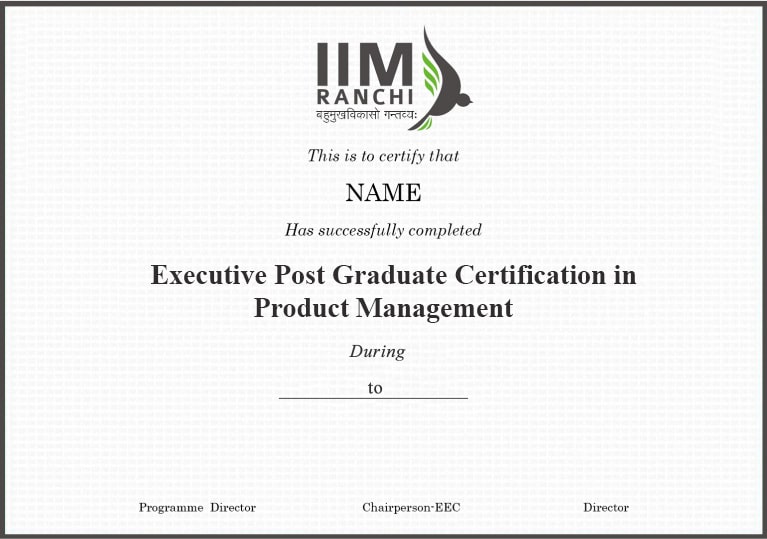
EPGC in Product Management Certificate Image Click to Zoom

Certification

  • Industry-recognized certification from IIM Ranchi.
  • Gain hands-on skills in product strategy, UX, agile, GTM, and more
  • Placement support with 3100+ Hiring Partners including top startups and MNCs

Reviews & Testimonials

(4,233)

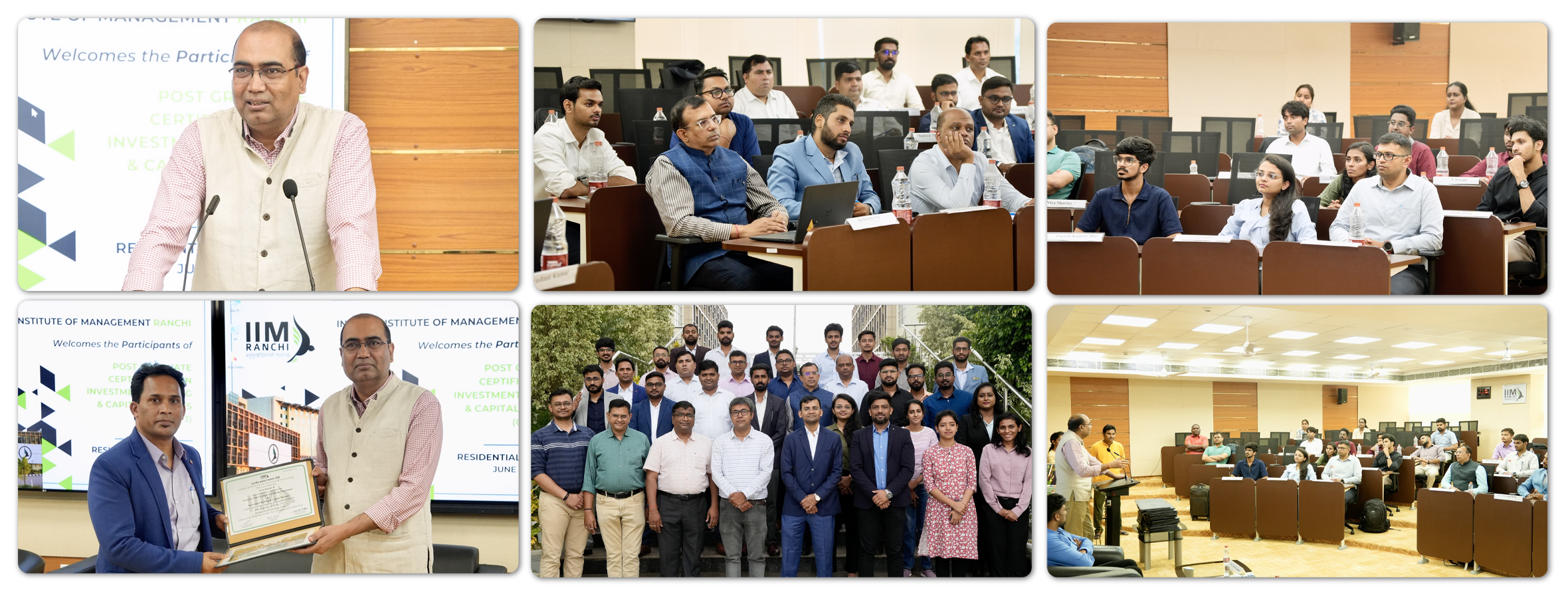
Engage in an enriching campus immersion experience with IIM Ranchi faculty, right at the IIM Ranchi campus.

Campus immersion at IIM Ranchi

Our Alumni work at

Product Management Alumni Image

Frequently Asked Questions

What can I expect from this Executive Post Graduate Certification in Product Management programme?

This Executive Post Graduate Certification in Product Management course has been designed by top experts with a deep understanding of industry requirements. The course covers various projects and assignments that will assist you in becoming job-ready and taking on challenging roles within the product management industry.

This Executive Post Graduate Certification in Product Management offers in-depth knowledge, hands-on projects, expert insights, and networking opportunities to help you succeed in the product management field.

Executive Post Graduate Certification in Product Management offers a wide range of job opportunities, including:

  • Product Manager: They guide the product vision and delivery via cross-functional team collaborations.
  • Product Owner: They prioritize features to maximize product value and customer satisfaction.
  • Product Marketing Manager: They create marketing strategies to promote products.
  • Strategic Product Planner: They are responsible for developing long-term product strategies based on market trends.

These roles exist in various industries and companies of all sizes. With the increasing demand for skilled product managers, the field provides promising career prospects and growth potential. There are 17,000+ job opportunities for professionals in India alone and over 1,35,000+ job opportunities in the USA.

The average salary for professionals in product management roles varies based on experience and industry. Generally, entry-level positions start from ₹6,00,000 per annum, while mid-level positions range from ₹10,00,000 to ₹18,00,000 per annum. Senior roles, such as Senior Product Manager or Head of Product, can command salaries upwards of ₹25,00,000 annually.

The course is taught by experienced faculty from IIM Ranchi and industry experts with extensive experience in product management. Practitioners from leading companies also provide insights into real-world challenges and best practices.

Upon successful completion, you will receive an Executive Post Graduate Certification in Product Management from IIM Ranchi, which is recognized and valued in the industry.

Intellipaat provides 24/7 query resolution, allowing you to raise a ticket to the dedicated support team anytime.  You can avail of email support for all your queries. If your query is not resolved through email, we can arrange one-on-one sessions with our support team. However, 1:1 session support is provided for 9 months from the start date of your course.

Intellipaat actively offers placement assistance to all learners who have completed the training. For this, we are exclusively tied up with over 300 top MNCs. This way, you can be placed in outstanding organizations such as Sony, Ericsson, TCS, Mu Sigma, Standard Chartered, Cognizant, and Cisco, among other equally great enterprises. We also help you with the job interview and résumé preparation.

Yes, Executive Post Graduate Certification in Product Management is highly valuable. It validates your expertise and knowledge in product management and enhances your credibility in the job market. It demonstrates your commitment to professional growth and can significantly increase your chances of securing rewarding career opportunities.

This Executive Post Graduate Certification in Product Management course introduces various industry-standard tools and platforms used in product management. These may include market research tools like surveys and customer feedback platforms, data analytics software for analyzing product performance and user behavior, project management tools for organizing and tracking tasks, and collaboration platforms for seamless team communication and coordination.

Yes, as per our refund policy, once the enrollment is done no refund is applicable.

Upon completing the course, candidates can apply for executive alumni status by paying Rs. 10,000 + GST directly to IIM Ranchi.

View More